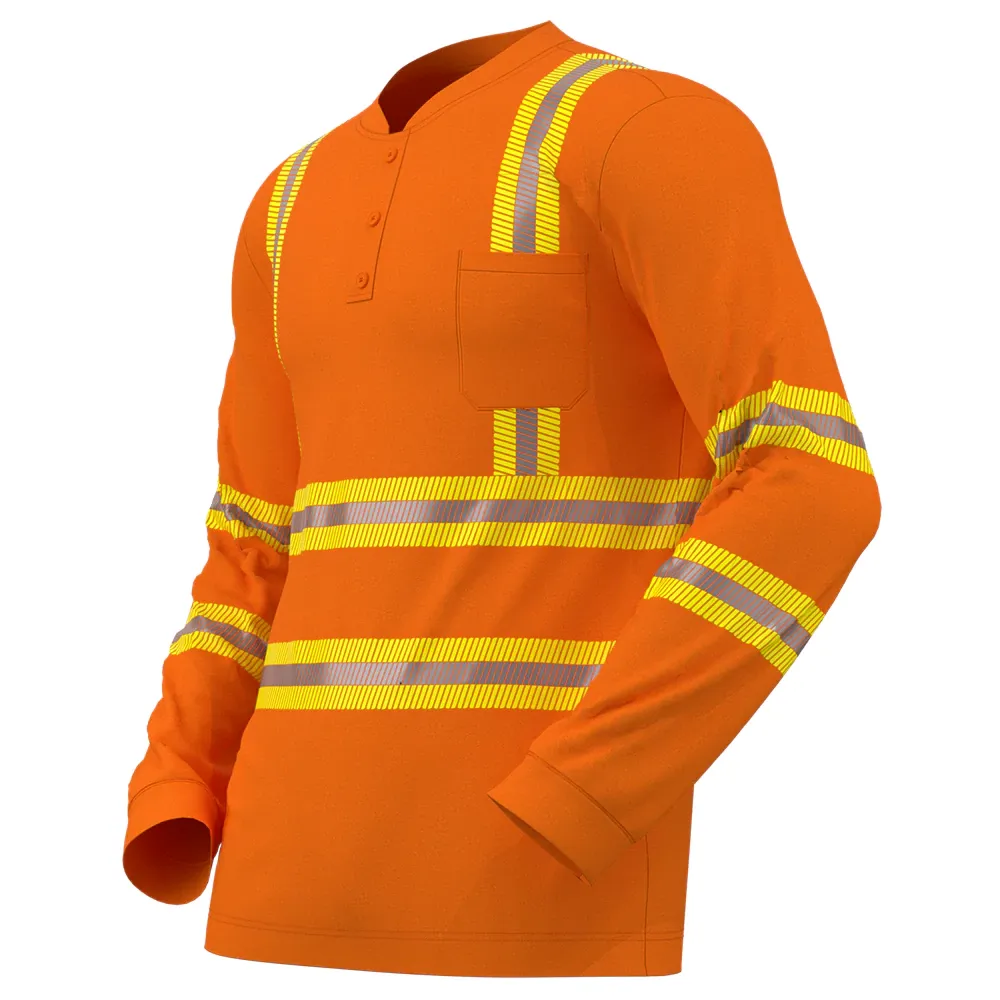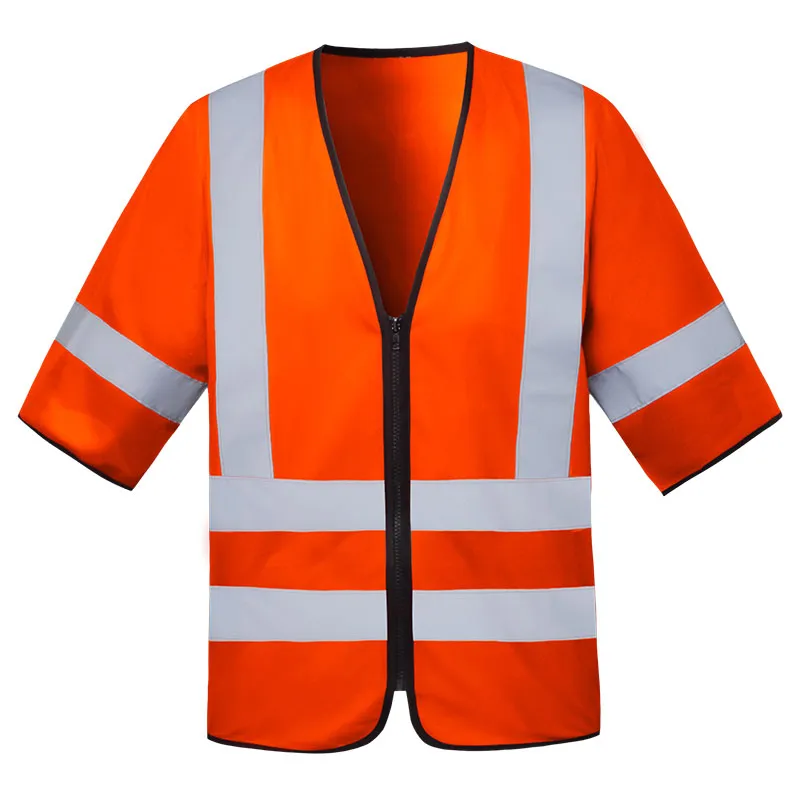
What Are the ISO 20471 Classes for a Hi-Vis Vest?
A US buyer who has specified ANSI/ISEA 107 garments will run into a different framework the moment a manufacturer's documentation is built around ISO 20471 instead. That's the standard governing high-visibility clothing across the EU and much of the international supply chain. ISO 20471:2013, with its 2016 amendment, splits high-visibility garments into Class 1, Class 2, and Class 3. Each step up requires more minimum fluorescent background and retroreflective material on the finished garment. Picking the right class isn't a color decision. It follows from a risk assessment covering vehicle speed, traffic density, sightlines, and the worker's actual task.
How Does a Hi-Vis Vest Actually Create Visibility?
A high-visibility vest pairs 2 complementary systems: daytime fluorescent background material and retroreflective material that sends light back toward its source in the dark.
Fluorescent background material helps a wearer stand out from the surrounding environment in daylight and low light. Retroreflective tape returns a significant portion of the light from a source, typically a vehicle headlight, back in the direction it came from.
"Reflective" and "retroreflective" get used interchangeably in casual conversation, but ISO 20471 technically evaluates only the measured performance of retroreflective material. A shiny gray strip on a garment doesn't automatically deliver the measurement result the standard requires.
A vest's real-world visibility depends on:
- The color and measured performance of the fluorescent material
- The performance of the retroreflective tape
- How much area each material covers on the finished garment
- Where the tape sits relative to the body
- The garment's size range
- Its condition after washing and wear
- Whether the vest is worn open or closed
Using standard-grade material doesn't guarantee compliance on its own. Misplaced tape, or background area eaten up by a logo or pockets, can pull the finished garment's effective class down.
What Does ISO 20471:2013 Actually Regulate?
ISO 20471:2013 sets requirements across 4 core performance areas for high-visibility clothing used in high-risk settings: color, retroreflection, material area, and placement.
ISO 20471:2013 defines the test methods and requirements for high-visibility garments intended to visually signal a wearer's presence to vehicle or machine operators. It covers both daylight conditions and nighttime illumination by vehicle headlights.
ISO 20471 has a published 2016 amendment: ISO 20471:2013/Amd 1:2016. The EU's harmonized standards decision dated June 12, 2026 lists EN ISO 20471:2013 and A1:2016 together.
As of August 11, 2026, ISO still lists the 2013 edition as the current published standard, while work continues on a second edition under ISO/DIS 20471. DIS stands for Draft International Standard, a stage that does not replace the published edition. Recheck the edition in force at the actual order date rather than relying on what was current when the specification was written.
How Much Material Does a Class 1 Vest Require?
ISO 20471 Class 1 requires a minimum of 0.14 m² of fluorescent background and 0.10 m² of retroreflective material on the finished garment.
Class 1 covers the smallest visible-area requirement in ISO 20471. That doesn't make it an automatic fit for every low-risk job. ISO 20471 as a whole addresses high-risk settings, and class selection still rests on the workplace risk assessment.
| Class 1 component | Minimum area |
|---|---|
| Fluorescent background material | 0.14 m² |
| Retroreflective material | 0.10 m² |
Holding the required area gets harder in smaller sizes. A logo, a clear ID pocket, a radio loop, or another accessory covering the fluorescent surface can pull the garment's calculated area below the threshold.
Don't select Class 1 for a site that calls for Class 2 or 3 just because it costs less. Vehicle speed, an operator's stopping distance, how close the worker gets to moving traffic, and visual clutter in the surrounding environment all belong in that decision.
Which Areas Does a Class 2 Hi-Vis Vest Need to Cover?
ISO 20471 Class 2 requires a minimum of 0.50 m² of fluorescent background and 0.13 m² of retroreflective material.
Class 2 carries a larger fluorescent and retroreflective surface than Class 1. It's one of the more common classes specified for work vests, but appearance alone doesn't confirm Class 2 status. The label, certificate, and finished-product design need to be checked together.
| Class 2 component | Minimum area |
|---|---|
| Fluorescent background material | 0.50 m² |
| Retroreflective material | 0.13 m² |
Details worth checking before approving a Class 2 vest:
- Visible area when the vest is worn closed
- Material quantity on the smallest available size
- Placement of shoulder and torso tape
- Area taken up by logo and ID pockets
- Which pre-wash treatment the sample was tested under
- The maximum care cycle stated in the user instructions
- Whether the certificate covers the exact model code
Wearing the vest open hides part of the body and undermines the overall visibility the standard designs for. The closure needs to actually be used on the job.
Why Isn't Class 3 High-Visibility Clothing Always a Vest?
ISO 20471 Class 3 requires a minimum of 0.80 m² of fluorescent background and 0.20 m² of retroreflective material; a small vest alone may not deliver that area.
Class 3 requires the largest visible-material area in ISO 20471. The garment has to be designed so an observer can recognize the wearer's shape from multiple angles. For Class 3 products under the standard, the tape arrangement across the torso and sleeves or full-length legs matters as much as the raw material total.
| Class 3 component | Minimum area |
|---|---|
| Fluorescent background material | 0.80 m² |
| Retroreflective material | 0.20 m² |
A sleeveless vest, especially in a small size, may not be able to meet Class 3's area and design requirements by itself. That's why Class 3 coverage typically comes from a long-sleeved jacket, parka, coverall, or an upper-and-lower ensemble defined together on a single certificate.
Adding up the areas of two separate garments yourself and calling the pair "Class 3" isn't a valid claim. The combination has to be defined that way in the relevant certificate and manufacturer instructions.
What's the Real Difference Between Class 1, 2, and 3?
The core difference across ISO 20471's 3 classes is the minimum area of fluorescent and retroreflective material on the finished garment.
| ISO 20471 class | Fluorescent background | Retroreflective material | General selection principle |
|---|---|---|---|
| Class 1 | 0.14 m² | 0.10 m² | Lower visible-area need identified in a risk assessment |
| Class 2 | 0.50 m² | 0.13 m² | Broader day and night visibility area |
| Class 3 | 0.80 m² | 0.20 m² | Largest visible surface and limb recognition |
This table doesn't replace a use-case decision. A pedestrian crossing, an open traffic lane, a yard area, and an enclosed production floor on the same site can carry very different risks.
A higher class doesn't mean protection against other hazards. ISO 20471 is not a standard for flame, electric arc, chemical splash, or mechanical risk. Where multiple hazards overlap, the relevant standards need to be evaluated together. The guide to flame-resistant workwear standards covers flame and heat risk separately.
Which Risks Should Drive Vest Class Selection?
The right class is set by at least 5 risk variables: vehicle speed, traffic density, sightlines, task duration, and available escape room.
The standard doesn't remove the employer's obligation to run a risk assessment. Roadwork, a port, airside operations, a logistics yard, a mine site, and an in-plant forklift lane all carry different movement and visibility conditions.
A risk assessment can work through these questions:
| Risk variable | Assessment question |
|---|---|
| Vehicle speed | How much time does an operator have to react after spotting the worker? |
| Traffic density | How many directions of movement surround the worker? |
| Sightlines | Is there fog, rain, dust, or darkness? |
| Background | Does the fluorescent color stand out from the surroundings enough? |
| Task | Is the worker stationary, bending, or getting in and out of vehicles? |
| Escape room | Can the worker move away from an approaching vehicle? |
| Task duration | Is the exposure a short task or a full shift? |
Whether a driver or machine operator recognizes a worker isn't purely about color. The garment showing a human silhouette, tape wrapping the body, and visible limb movement all support recognition.
The final class decision should be verified with your safety officer against the applicable regulation and site conditions; it isn't a substitute for either.
How Do You Choose Between Yellow, Orange-Red, and Red?
ISO 20471 defines 3 fluorescent background color areas: fluorescent yellow, fluorescent orange-red, and fluorescent red.
Color choice shouldn't come down to corporate preference. Factor in the ground, vehicles, equipment, vegetation, and signage in the actual work environment. The goal is standing apart from it.
Orange-red might give better visual separation on a road-maintenance crew, while yellow works better on a different industrial site. Either way, a fabric simply looking bright to the eye doesn't prove standard compliance; the color has to meet the relevant measurement conditions.
When a logo or contrast-color panel gets added to the fluorescent area, recheck the class calculation. A large back print can eat into the visible background quantity. For company branding on standard workwear, see the custom logo workwear guide. On protective garments, though, the standard documentation always takes priority over the branding.
Why Does Tape Width and Placement Matter So Much?
ISO 20471 compliance is judged not just on tape area but on how the layout wraps the body, and where required the limbs, for 360-degree visibility.
The total square-meter figure for retroreflective material isn't sufficient on its own. Where the tape sits relative to itself, the garment edges, and the armholes has to match the standard's design requirements.
Dense tape on the front of a vest with a break in continuity on the back affects how visible the worker is from different approach directions. If a radio loop, pocket flap, or logo panel interrupts that continuity, the finished design needs another look.
A sample check should measure:
- Continuity of the bands wrapping the torso
- Front-to-back connection of shoulder bands
- The gap between bands
- Placement of sleeve and leg bands
- How the product looks with the zipper closed
- Total material area on the smallest available size
- Remaining surface after logo and accessories
A catalog photo or a tape swatch on a table doesn't prove finished-product compliance. The model-specific certificate and the physical product marking need to be reviewed together.
What's the Difference Between EN 17353:2020 and ISO 20471?
EN 17353:2020 addresses medium-risk situations; ISO 20471:2013 addresses high-risk visibility conditions tied to vehicles and mechanized equipment.
EN 17353 sets test and design requirements for equipment providing enhanced visibility in medium-risk situations. The EU's harmonized standards decision 2026/1279 lists EN 17353:2020 and EN ISO 20471:2013 as separate standards.
The medium-risk versus high-risk distinction isn't something a purchasing team should decide purely from a product's marketing name. It calls for evaluating the worker's interaction with vehicles, speed, sightlines, and the site's regulatory obligations.
| Standard | Core use case | Classification approach |
|---|---|---|
| EN 17353:2020 | Enhanced visibility in medium-risk situations | Daytime, dark, or combined-use types |
| ISO 20471:2013 | High visibility in high-risk situations | Class 1, Class 2, and Class 3 |
| ISO 13688:2013 | General requirements for protective clothing | Doesn't set a visibility class on its own |
ISO notes a draft ISO 23762 is in development for medium-risk visibility products. Don't treat that draft as a published substitute for EN 17353 or any other standard currently in force.
What Does ISO 13688 Add to a Hi-Vis Vest?
ISO 13688:2013 covers 6 general areas separate from the visibility class: ergonomics, innocuousness, sizing, ageing, marking, and user information.
ISO 13688:2013 defines general performance requirements for protective clothing. ISO states clearly that this standard needs to be used alongside hazard-specific performance standards; it should never stand alone.
For a hi-vis vest, ISO 13688 typically covers:
- How well the sizing matches the wearer
- Whether the garment restricts movement
- Innocuousness of materials and accessories
- The effect of ageing and care on properties
- Marking and label information
- The manufacturer's use instructions
- Compatibility with other protective products
ISO 13688:2013 has a published 2021 amendment. ISO states the main standard was reviewed again in 2024 and confirmed current. Check the link between the main standard and the amendment in the technical file.
How Does Washing Affect Retroreflective Performance?
The color and retroreflective performance of a high-visibility vest still have to meet the certification scope after the care process and maximum wash cycle stated on the label.
Dirt, grease, paint, and dust can cover the fluorescent surface or tape and reduce visibility. Physical abrasion, folding, high heat, or the wrong chemical exposure can also degrade how the materials behave.
Look for this information in the product's use instructions:
| Care area | What to check |
|---|---|
| Washing | Permitted program and maximum cycle |
| Detergent | Substances restricted by the manufacturer |
| Bleach | Whether it's permitted |
| Drying | Applicable method |
| Ironing | Limits for tape and fabric |
| Repair | Suitable material and method |
| Retirement | Damage or visible-soiling criteria |
Hitting the maximum cycle on the label doesn't automatically mean the vest is still usable at that point. Nor does it mean a vest that's damaged, permanently soiled, or has separating tape earlier than that should stay in service. Field inspection should retire it sooner if needed.
Custom branding needs to hold up under the same care conditions as the base garment. A logo application shouldn't sit on top of the tape or cut into the certified visible area.
How Do You Check CE Marking and Product Certification?
High-visibility PPE placed on the EU market needs 4 records checked together: the CE mark, the model certificate, the declaration of conformity, and the user instructions.
EU Regulation 2016/425 on personal protective equipment sets essential health and safety requirements for PPE placed on the European Union market. This is EU market law. It applies to programs shipping into the EU, not to placing a product on the market in the United States, and it doesn't replace whatever domestic requirement governs use at a US worksite.
For a US buyer, this framework matters in two situations: sourcing product that will also ship into the EU, or auditing an international manufacturer whose factory documentation is built around ISO standards and CE conformity rather than ANSI/ISEA 107.
During product review, the ISO 20471 class on the label needs to match the model code in the technical file. A test report belonging to a different vest, or documentation covering only a fabric swatch, doesn't on its own prove the finished garment's conformity.
Look for this information on the certificate:
- Manufacturer and model description
- Garment class
- The applied standard's edition
- Size range
- Material references
- Certification body information
- Validity and revision status
For placement and workplace use outside the EU, confirm the domestic regulatory requirements that actually apply at the destination. A tender or purchase specification should be verified by your safety and compliance staff.
How Should Sampling and Bulk Production Be Planned?
At TB Uniform, the minimum order is 100 pieces per color and style, sample lead time runs 5–7 business days, and production and delivery generally take 4–6 weeks after approval.
A production plan for high-visibility product shouldn't start before the standard class is set. Since material area changes by size, the smallest available size needs its own sample check.
A sample evaluation can record:
| Sample area | Approval point |
|---|---|
| Class | Class 1, 2, or 3 |
| Color | Fluorescent color within the standard |
| Background area | Square meters on the smallest size |
| Tape area | Square meters on the smallest size |
| Placement | Torso, shoulder, sleeve, or leg layout |
| Logo | Size and position that don't reduce visible area |
| Label | Standard, class, and care information |
| Sizing | Fit with movement and other equipment |
TB Uniform manufactures vests, jackets, trousers, coveralls, and other high-visibility products at its Istanbul facility. A compliance claim rests on the finished model's documentation scope, not just on the use of retroreflective tape.
Monthly production capacity can reach up to 50,000 pieces depending on the product group. When an order spans multiple models, classes, or colors, plan the 100-piece threshold and material sourcing separately for each variant. The minimum order quantity guide breaks that planning down further.
How Do You Make the Final Call on Vest Class?
The final decision pairs 1 field risk assessment with the ISO 20471 class, model certificate, smallest available size, and care plan.
Deciding among ISO 20471 hi-vis vest classes shouldn't come down to color or tape count alone. Class 1, 2, and 3 each represent a minimum area of fluorescent background and retroreflective material.
The worker's relationship to vehicles and machinery, speed, approach direction, weather, and task duration all belong in the risk assessment. Once the class is set, check the finished product's certificate, label, size range, and user instructions.
The next edition of ISO 20471 remains at the draft stage as of August 2026. On new contracts, recheck the published edition in force at order date, along with any applicable national or industry rules. Contact TB Uniform for samples and a quote.
Frequently Asked Questions
How many classes does high-visibility hi-vis clothing have under ISO 20471?
Under ISO 20471:2013, high-visibility garments are split into 3 classes: Class 1, Class 2, and Class 3. Each step up requires more fluorescent background and retroreflective material. Which class to use is set by a risk assessment covering vehicle speed, traffic, sightlines, and the worker's task, not by price.
What does a Class 2 hi-vis vest mean?
A Class 2 garment must carry at least 0.50 m² of fluorescent background and 0.13 m² of retroreflective material, measured on the finished product and the relevant size. Appearance, color, or tape count alone don't prove the class; the label, model certificate, material placement, and user instructions need to be checked together.
Can a sleeveless vest be Class 3?
Class 3 requires at least 0.80 m² of fluorescent and 0.20 m² of retroreflective area, plus a tape layout across the torso and sleeves or full-length legs. A small sleeveless vest may not meet those conditions on its own. Class 3 coverage can come from a certified jacket, coverall, or an ensemble defined by the manufacturer.
Does a yellow hi-vis vest automatically comply with ISO 20471?
No. A bright yellow appearance alone doesn't confirm ISO 20471 compliance. The measured result of the fluorescent color, the retroreflective tape's performance, the minimum material area, the placement on the garment, and post-care behavior all need evaluation. The finished model's certificate and label should show the same product code and class. A general fabric or tape document isn't enough.
Does a logo affect a vest's class?
Yes. A large logo, ID pocket, or contrast panel can cover certified fluorescent background area. If the application sits on top of the retroreflective tape, it can also break tape continuity. Logo size and placement should be evaluated on the smallest available size before bulk production, and any change needs to stay within the design limits the model certificate allows.
What's the minimum order for a hi-vis vest?
At TB Uniform, the minimum order is 100 pieces per color and style. Different ISO 20471 classes, colors, or vest models each create separate production variants. Once technical suitability and material scope are confirmed, a sample can be ready in 5–7 business days. Production and delivery on approved orders generally take 4–6 weeks.