ANSI 107 Compliant Hi-Vis Clothing, Explained
ANSI 107 compliant hi-vis clothing must meet ANSI/ISEA 107-2020 requirements for garment type, performance class, fluorescent background material, retroreflective material, design, testing, and labeling. The standard sorts garments into Types O, R, and P by work setting, assigns Performance Classes 1 through 3, and adds supplemental Class E items that never qualify as high-visibility apparel on their own.
What is ANSI/ISEA 107-2020?
ANSI/ISEA 107-2020 is the current American National Standard for high-visibility safety apparel, as listed by ISEA on August 11, 2026.
The standard sets requirements for garments meant to keep workers conspicuous in daylight, low light, and darkness. It covers material color, retroreflection, minimum visible areas, material placement, garment design, testing, care information, and labels.
The International Safety Equipment Association standards directory lists ANSI/ISEA 107-2020 as the current edition. ANSI is the American National Standards Institute; ISEA is the standards-developing organization behind this document.
One point trips up many buyers: neither ANSI nor ISEA tests or "certifies" individual garments. The finished-item manufacturer relies on the required test evidence, verifies conformity, labels the item, and issues a Declaration of Conformity for that model.
So a product listing that says only "ANSI vest" or "high vis" tells you almost nothing. You need the standard edition, type, class, model, label, and conformity documentation.
What is the difference between garment type and performance class?
Garment type describes the expected work setting; performance class describes the minimum visible-material configuration within that setting.
ANSI/ISEA 107 divides work environments into three garment types:
| Garment type | Intended setting |
|---|---|
| Type O | Off-road occupational environments |
| Type R | Roadway and temporary traffic-control environments |
| Type P | Public-safety activities |
ISEA introduced this type system in the 2015 edition and kept it in the 2020 standard. The ISEA explanation of garment types identifies Type O as off-road, Type R as roadway and temporary traffic control, and Type P as public safety.
Performance class then governs how much fluorescent background and retroreflective or combined-performance material the garment must carry, and how it must be arranged.
Always state type and class together. "Class 2" on its own does not tell you whether a garment is Type R or Type P.
What is Type O, Performance Class 1?
Type O, Class 1 is the ANSI/ISEA 107 category for off-road occupational settings with moving-equipment hazards but no roadway exposure.
Typical settings include warehouses, parking operations, mining, and oil and gas sites: controlled workplaces where struck-by hazards exist without road traffic. The employer's hazard assessment decides whether the actual exposure fits Type O.
A 2024 Connecticut OSHA technical summary lists these Class 1 minimums:
- 217 square inches of background material,
- 155 square inches of retroreflective or combined-performance material,
- 1-inch retroreflective material width.
Treat these figures as a working reference. The purchased ANSI/ISEA 107-2020 standard and the applicable test documents control the final design.
Do not select Type O, Class 1 for roadway work that calls for Type R Class 2 or 3.
What is Type R, Performance Class 2?
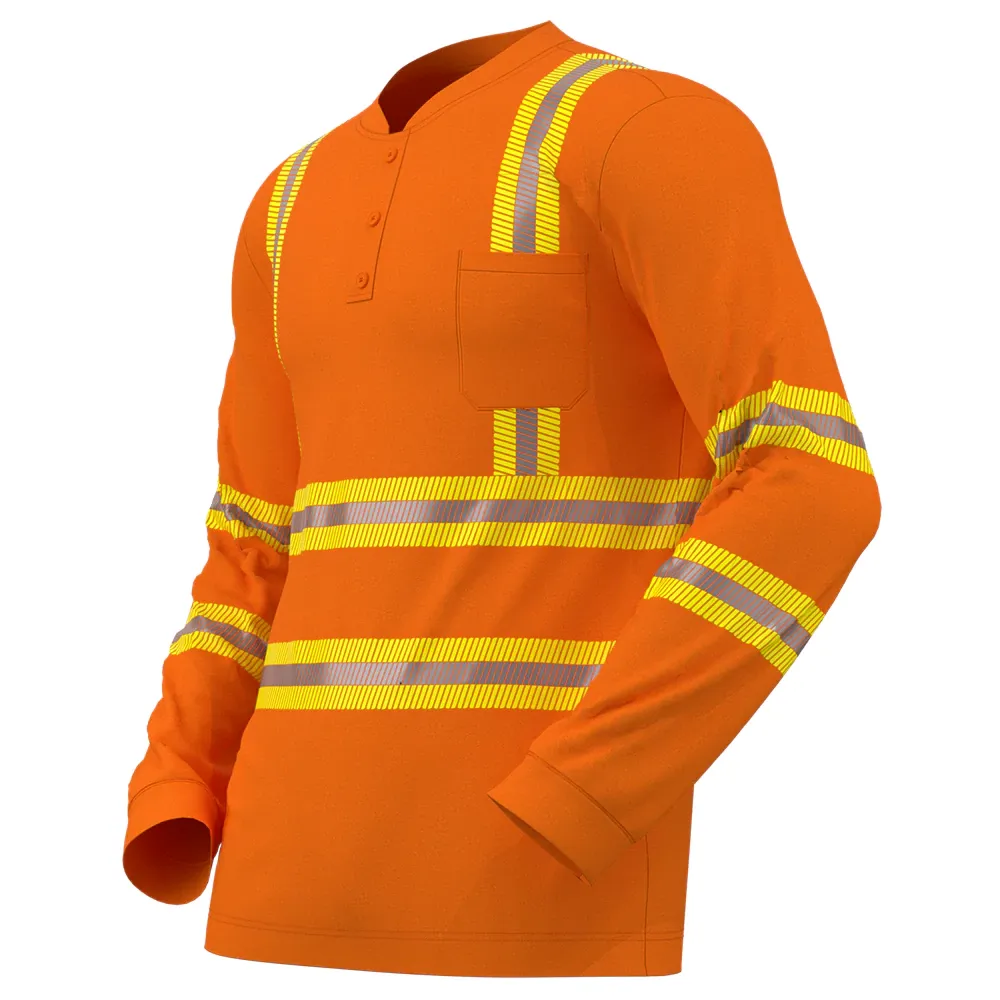
Type R, Class 2 is designed for roadway and temporary traffic-control exposure that demands more conspicuity than Type O, Class 1 provides.
Type R Class 2 usually takes the form of a vest, shirt, jacket, or other upper-body garment. The word "vest" by itself establishes nothing about compliance.
Per the Connecticut OSHA summary, Class 2 requires:
- 775 square inches of background material,
- 201 square inches of retroreflective or combined-performance material,
- prescribed material widths and configurations.
The same summary notes a reduced background-material provision for the smallest Type R size: 540 square inches for Class 2. That exception exists so smaller workers can wear garments that actually fit. It is not an invitation to hand out oversized ones.
A compliant label identifies Type R, Performance Class 2, and the applicable ANSI/ISEA 107 edition. Ask for the model-specific Declaration of Conformity as well.
What is Type R, Performance Class 3?
Type R, Class 3 delivers the highest performance class through more visible material arranged to make human movement easier to recognize.
The Connecticut OSHA summary lists for Class 3:
- 1,240 square inches of background material,
- 310 square inches of retroreflective or combined-performance material,
- prescribed Class 3 material widths and placement.
For the smallest Type R size, the reduced background-material minimum is 1,000 square inches. That provision applies within the standard's sizing rules; it does not extend to every garment size.
Class 3 apparel typically uses sleeves, full-body garments, or an approved ensemble so an observer can recognize the wearer's human form. A sleeveless product is not Class 3 just because of its color or its marketing copy.
The 2023 MUTCD advises Class 3 apparel for nighttime flagging. Selecting the right class for work under that section remains the responsibility of the employer's designated safety person.
What are Type P Classes 2 and 3?
Type P covers public-safety activities and offers Class 2 and Class 3 configurations for responders who need visibility plus access to duty equipment.
Public-safety garments often need shorter cuts, side access, breakaway features, or compatibility with duty gear. Type P allows for those operational needs while holding defined high-visibility performance.
The Connecticut OSHA summary gives these minimums:
| Type P class | Background material | Retroreflective or combined-performance material |
|---|---|---|
| Class 2 | 450 square inches | 201 square inches |
| Class 3 | 775 square inches | 310 square inches |
Type P is not a loophole for using less background material. The wearer and the activity must genuinely fall within the public-safety scope.
Firefighters and responders directly exposed to flame, heat, or hazardous materials may need turnout gear governed by other requirements. High visibility must be integrated with the primary hazard protection, never substituted for it.
What is supplemental Class E apparel?
Supplemental Class E covers lower-body items that can build a Class 3 ensemble when worn with compliant Class 2 or 3 upper-body apparel.
Class E items include pants, bib overalls, shorts, and gaiters made with approved background and retroreflective or combined-performance materials.
Worn alone, Class E apparel does not satisfy the high-visibility safety-apparel requirement. The Connecticut OSHA summary states that pairing it with a Performance Class 2 or 3 upper garment can produce an overall Class 3 ensemble.
The buyer must confirm the compatibility and documentation of the complete ensemble. A random fluorescent pant plus a Class 2 vest does not automatically add up to a compliant Class 3 system.
Garment records should name the upper and lower models approved for combined use, and employees need training on which pieces belong together.
How much visible material does each class require?
ANSI/ISEA 107 performance classes rest partly on minimum material areas, not on a garment's color, price, or marketing name.
This buyer reference is based on the 2024 Connecticut OSHA summary of ANSI/ISEA 107-2020:
| Type and class | Minimum background area | Minimum retroreflective or combined area |
|---|---|---|
| Type O, Class 1 | 217 square inches | 155 square inches |
| Type R, Class 2 | 775 square inches | 201 square inches |
| Type R, Class 3 | 1,240 square inches | 310 square inches |
| Type P, Class 2 | 450 square inches | 201 square inches |
| Type P, Class 3 | 775 square inches | 310 square inches |
The standard also controls material width, placement, gaps, orientation, continuity, garment design, and performance. Hitting one area figure does not prove the finished item conforms.
Pockets, dark panels, zippers, logos, and mesh sections all eat into the available compliant area, and size grading changes the math for every size. Designers must validate each offered size, including any small-size provisions.
Which fluorescent colors are permitted?
ANSI/ISEA 107 background and combined-performance materials use fluorescent yellow-green, fluorescent orange-red, or fluorescent red within defined performance limits.
Fluorescent red appears less often in the field, but the Connecticut OSHA summary identifies it. Whatever the color, the material must meet the standard's chromaticity and luminance requirements. An ordinary bright dye does not qualify.
A separate governing document may narrow the choice further. Section 6C.05 of the 2023 MUTCD Part 6 identifies fluorescent orange-red, fluorescent yellow-green, or a combination for workers in its covered temporary traffic-control zones.
Beyond the rules, pick a color that contrasts with the actual work environment. Yellow-green can fade into vegetation or equipment; orange-red can blend with certain barriers or backgrounds.
Color selection is both a standards question and a site-specific contrast decision.
How do fluorescent and retroreflective materials differ?
Fluorescent material supports daytime conspicuity; retroreflective material returns light toward its source for low-light and nighttime recognition.
Fluorescent material converts ultraviolet energy into extra visible brightness under suitable daylight. At night it does little, so it cannot replace retroreflective material.
Retroreflective material sends light approximately back toward its source, such as vehicle headlights. How well it works depends on material performance, garment orientation, cleanliness, viewing geometry, and illumination.
Combined-performance material fulfills defined fluorescent and retroreflective functions under the standard. Do not confuse it with decorative silver trim.
A compliant garment arranges these materials so an observer can recognize a person, including body orientation and motion. Piling on tape achieves nothing if the design and placement do not conform.
What information should appear on the garment label?
A compliant label identifies the manufacturer, product, size, standard edition, garment type, performance class, and prescribed care or flame-resistance information.
Compare the sewn label against the product specification and the Declaration of Conformity. A web listing cannot stand in for the physical label.
ISEA warns in its PPE purchasing guidance that "ANSI certified" is misleading, because ANSI and ISEA do not certify individual products. When a claim looks uncertain, ISEA advises requesting current testing documentation.
A practical procurement check covers:
- exact ANSI/ISEA 107 edition,
- type and class,
- model and size,
- care limitations,
- manufacturer or responsible party,
- Declaration of Conformity.
A missing, inconsistent, or poorly printed label should stop approval until the supplier resolves the discrepancy.
Is enhanced-visibility clothing ANSI 107 compliant?
Enhanced-visibility clothing may improve conspicuity, but it does not qualify as ANSI/ISEA 107 apparel unless it meets every applicable requirement.
A fluorescent company shirt with decorative reflective stripes can serve a purpose in a controlled workplace. It must not be sold or purchased as compliant high-visibility safety apparel without the required testing, design, label, and declaration.
The Connecticut OSHA summary explicitly separates enhanced-visibility uniforms from ANSI/ISEA 107 high-visibility safety apparel. On roadways and in other regulated environments, that distinction carries real weight.
Reject vague phrases such as:
- "ANSI colors,"
- "Class 2 style,"
- "OSHA orange."
The specification must state the exact type, class, and standard edition, and the label and conformity documents must match it.
Does ANSI 107 apparel protect against flame or arc hazards?
ANSI/ISEA 107 addresses conspicuity only; it does not automatically provide flame resistance, arc rating, chemical protection, or weather protection.
A high-visibility vest can melt, burn, or fail in a heat exposure unless it carries separate, applicable protective properties. The ANSI/ISEA label states flame-resistance characteristics precisely so the wearer is not misled by appearance.
Where traffic hazards overlap with flame, arc, chemical, or thermal hazards, the employer must select apparel that satisfies all relevant requirements. Layering creates its own risk: a non-flame-resistant hi-vis garment worn over protective clothing can undermine the protection beneath it.
Never describe a product as flame resistant merely because its retroreflective tape resembles material used on firefighter clothing.
The article on flame-resistant workwear standards covers NFPA and related protective requirements separately.
How should logos and dark panels be controlled?
Logos, pockets, dark panels, and personalization must preserve the minimum compliant material areas, required placement, visibility, and label information.
Dark lower panels hide dirt well, but they can cut into fluorescent background area. A large back logo can cover compliant material. Embroidery may interrupt a fabric or tape section, and a patch can conceal required labeling.
The decorated garment must remain conforming in every offered size. In practice, the smallest size sets the tightest material-area constraint.
A decoration specification should record:
- approved logo dimensions,
- fixed placement,
- material area remaining after decoration.
Printing and embroidery can happen during manufacturing, but the safety specification governs the branding, not the other way around. The custom logo workwear guide walks through the approval process.
How should fit and layering be evaluated?
Correct fit keeps the garment closed, visible, mobile, and compatible with the intended seasonal and protective layers.
An oversized vest snags on equipment and lets reflective bands drift out of position. An undersized jacket may not close over winter clothing, distorting the compliant design.
Evaluate each size on the layers workers will actually wear. Harnesses, radios, tool belts, backpacks, rainwear, and outer coats all cover visible material.
The 2015 update introduced reduced background-material provisions for the smallest Type R Class 2 and 3 sizes, recognizing that smaller workers need garments that actually fit. Oversizing is not a substitute for correctly graded compliant apparel.
A fit set and physical sample normally take 5 to 7 business days for custom development.
How should ANSI 107 apparel be inspected and replaced?
Replacement should follow garment condition and manufacturer instructions, not a universal number of months, shifts, or wash cycles.
Inspect for:
- fading or loss of fluorescent brightness,
- permanent heavy soil,
- cracked, abraded, detached, or missing reflective material,
- tears, failed closures, or altered fit,
- unauthorized printing, embroidery, patches, or repair,
- unreadable compliance labels.
The Connecticut OSHA summary recommends considering replacement when brightness, reflectivity, or general condition is noticeably faded, soiled, burned, heavily abraded, or damaged compared with a new garment.
Laundry practices affect both fluorescent and retroreflective performance. Follow the care instructions; avoid unsupported bleach, softener, drying, or repair methods.
How should a buyer specify ANSI 107 garments?
A complete purchasing specification identifies nine items: edition, type, class, garment, color, materials, sizes, labels, and documentation.
Start the request with the hazard assessment and the governing OSHA, MUTCD, state, or contract requirement. Then state the precise product configuration.
A procurement checklist should cover:
- ANSI/ISEA 107-2020 type and performance class,
- garment category and approved color,
- every required size and layer,
- logo and personalization limits,
- label and Declaration of Conformity,
- material and finished-model test evidence,
- care and inspection instructions,
- sample approval,
- packaging and delivery.
The guide to OSHA high-visibility requirements explains when the employer may need this apparel; this article covers what the specified product must be.
Where is custom high-visibility workwear produced?
Custom garments are manufactured in Istanbul and exported to North America, with no US factory, office, warehouse, or same-day replacement inventory.
TB Uniform produces high-visibility workwear from buyer-approved specifications with a minimum order of 100 pieces per color and style. Monthly capacity reaches up to 50,000 pieces depending on the product group.
Once the sample and order are approved, production and delivery normally take 4 to 6 weeks. That makes international sourcing a fit for planned programs, not for the immediate replacement of individual safety garments.
Before use, the employer must verify the exact model, documentation, US requirements, state rules, and project specification. Where same-day replacement is operationally required, keep internal reserve stock or a verified domestic supplier.
What proves that hi-vis clothing is ANSI 107 compliant?
Compliance rests on matching test evidence, finished-model verification, the sewn label, and the manufacturer's Declaration of Conformity.
If ANSI 107 compliance had to fit in one phrase, it would be "type plus class plus evidence." Fluorescent color, reflective-looking tape, a marketplace badge, or an "OSHA approved" claim proves nothing.
Verify four records before release:
- the governing hazard and rule,
- the exact ANSI/ISEA 107-2020 type and class,
- the model label and Declaration of Conformity,
- the approved finished sample.
Custom programs also need a size matrix, a decoration map, an inspection procedure, and a replacement rule. Quantity planning is covered in the bulk employee uniform guide.
For a sample and quote, contact TB Uniform.
Frequently Asked Questions
What is the current ANSI standard for high-visibility clothing?
As of August 11, 2026, ISEA lists ANSI/ISEA 107-2020 as the current American National Standard for High-Visibility Safety Apparel. Buyers should state the full edition, garment type, and performance class, then verify the sewn label, Declaration of Conformity, and model-specific test evidence.
What is the difference between Type O, R, and P?
Type O addresses off-road occupational settings, Type R addresses roadway and temporary traffic-control environments, and Type P addresses public-safety activities. The type describes the expected use setting; the performance class separately sets minimum visible-material and garment-configuration requirements within that type.
Is Class 3 always better than Class 2?
No. Class 3 provides a larger, more conspicuous configuration, but the employer should select the class required by the hazard assessment, applicable rule, MUTCD, state requirement, and work conditions. The 2023 MUTCD specifies Class 2 or 3 for covered workers and assigns selection to the employer's safety designee.
Can Class E pants be worn by themselves?
No. Supplemental Class E items do not independently satisfy the high-visibility safety-apparel requirement. Approved pants, overalls, shorts, or gaiters are worn with compliant Class 2 or Class 3 upper-body apparel to create a documented Class 3 ensemble under the applicable ANSI/ISEA rules.
Does ANSI or ISEA certify high-visibility garments?
No. ANSI and ISEA do not certify individual PPE products. The manufacturer relies on required testing, verifies that the finished model conforms, labels it, and provides a Declaration of Conformity. Treat unsupported "ANSI certified" or "OSHA approved" claims as warning signs.
Does TB Uniform keep ANSI 107 apparel in US inventory?
No. Custom garments are manufactured in Istanbul and exported to North America. There is no US factory, office, warehouse, local inventory, same-day service, or domestic return location. Employers should maintain inspected replacement stock or use a verified US inventory supplier for urgent PPE needs.
Alt Texts
- ANSI/ISEA 107 garment types O, R, and P with performance classes
- Table of minimum background and retroreflective material areas by class
- High-visibility garment label showing type, class, and standard edition
- Class 2 upper garment combined with supplemental Class E pants