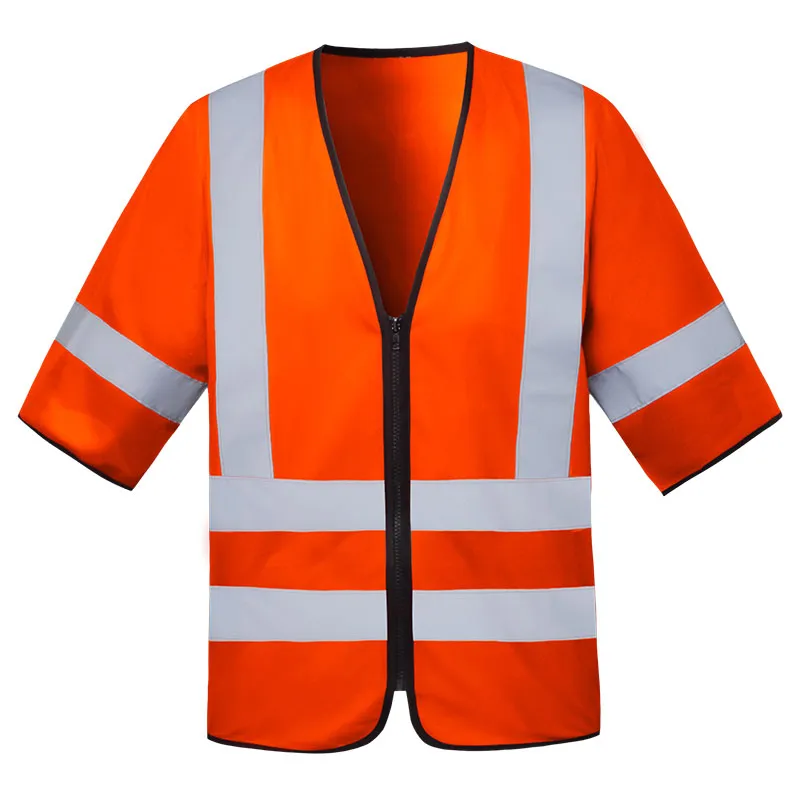
OSHA High-Visibility Clothing Requirements, Explained
Two OSHA construction standards name high-visibility apparel directly: flagger signaling under 29 CFR 1926.201(a) and excavation work exposed to public traffic under 29 CFR 1926.651(d). Beyond those, OSHA has interpreted the General Duty Clause to require high-visibility garments for road-construction workers exposed to traffic, and the 2023 MUTCD sets ANSI/ISEA 107 Performance Class 2 or 3 as the standard for temporary traffic-control zones, with the employer's designated safety person choosing the class.
Is high-visibility clothing an OSHA requirement for every worker?
No single OSHA rule mandates high-visibility apparel for every employee, industry, or task.
Whether it applies depends on the job, the OSHA standard in play, any recognized struck-by hazard, federal or state transportation rules, and what the employer's own hazard assessment turns up.
A handful of construction activities carry an express requirement. Many other tasks end up needing high-visibility apparel anyway, because the worker is exposed to moving traffic, construction vehicles, forklifts, mobile equipment, or some other recognized hazard OSHA expects the employer to address.
Two mistakes show up often, in opposite directions: treating any fluorescent vest as automatic OSHA compliance, and assuming no rule applies simply because a task isn't spelled out by name in a single section.
The real test is whether workers can be seen early enough by the operators of vehicles and equipment around them. Clothing is one piece of a larger control plan that can also include traffic separation, barriers, spotters, lighting, signage, alarms, and safe work procedures.
Which construction workers does OSHA name directly?
OSHA names flaggers under 29 CFR 1926.201(a) and excavation employees exposed to public traffic under 29 CFR 1926.651(d).
29 CFR 1926.201(a) requires flagger signaling and warning garments to conform to Part 6 of the Manual on Uniform Traffic Control Devices (MUTCD), which the standard incorporates by reference.
For excavation work, OSHA requires that employees exposed to public vehicular traffic be provided with, and wear, warning vests or other suitable garments made from or marked with reflectorized or high-visibility material.
Each situation below rests on a different federal basis:
| Worker or situation | Federal basis |
|---|---|
| Construction flagger | 29 CFR 1926.201(a) and incorporated MUTCD provisions |
| Excavation employee exposed to public traffic | 29 CFR 1926.651(d) |
| Other highway or road construction worker exposed to traffic | General Duty Clause interpretation |
| Worker in a temporary traffic-control zone | Applicable MUTCD and transportation requirements |
| Other workplace with moving-equipment exposure | Hazard assessment and applicable industry rules |
A job title alone doesn't settle the question. The employer has to evaluate the actual task the worker is performing.
What has OSHA said about highway work-zone crews?
OSHA reads the General Duty Clause as requiring high-visibility garments where highway and road workers face struck-by hazards from traffic.
In an August 5, 2009 interpretation letter, OSHA described moving road and construction traffic as an obvious, recognized hazard, and concluded that high-visibility garments are a feasible way to protect exposed road-construction workers.
An interpretation letter isn't a new standard; it's OSHA's reading of the standards already on the books. Employers should treat it as one input among current regulations, MUTCD requirements, project contracts, and state rules.
OSHA's struck-by hazards resource for construction makes the same point about visibility near roadways and moving equipment. High-visibility apparel doesn't replace traffic-control devices, safe equipment operation, backup procedures, or worker training. It works alongside them.
What does the MUTCD require inside a temporary traffic-control zone?
Section 6C.05 of the 2023 MUTCD calls for Class 2 or 3 high-visibility apparel for anyone working inside the right-of-way and temporary traffic-control zone.
The 11th Edition MUTCD, Part 6, dated December 2023, covers both daytime and nighttime activity. It requires workers, including emergency responders, inside the right-of-way and temporary traffic-control zone to wear high-visibility safety apparel meeting ANSI/ISEA 107-2015 Performance Class 2 or 3, or an equivalent later edition, subject to a few stated exceptions.
Who picks the class isn't left open: the employer's designated safety person makes that call.
Section 6C.05 recognizes these background material colors:
- fluorescent orange-red,
- fluorescent yellow-green,
- a combination of the two.
For retroreflective material, it treats orange, yellow, white, silver, yellow-green, or fluorescent versions as permissible under the cited standard framework.
For nighttime flagging specifically, the MUTCD's guidance points to Class 3. Because editions and jurisdictional requirements vary, employers need to confirm what actually governs their project rather than lean on a product listing alone.
Is ANSI/ISEA 107 itself an OSHA law?
Not on its own. ANSI/ISEA 107 is a consensus product standard that becomes binding through incorporation, another governing rule, contract language, or hazard-control logic.
The International Safety Equipment Association lists ANSI/ISEA 107-2020 as the current American National Standard for High-Visibility Safety Apparel, as of August 11, 2026.
What actually requires compliant apparel is a mix of OSHA regulations, incorporated MUTCD provisions, state rules, project specifications, and the employer's own hazard assessment. A voluntary consensus standard doesn't become a universal federal mandate just by existing.
Buyers should document both the legal basis and the product standard together. A specification that just says "OSHA vest" leaves out the ANSI/ISEA edition, garment type, performance class, size, required label, and intended use. None of that can be assumed.
The companion guide, ANSI 107 compliant hi-vis clothing, explained, walks through types, classes, markings, and purchasing checks in more depth.
What separates Performance Class 2 from Class 3?
Class 2 and Class 3 are different minimum configurations of background and retroreflective material under ANSI/ISEA 107, not employee ranks.
Class 3 gives a more conspicuous human silhouette than Class 2, through more material and a different garment configuration. Neither class is a badge; both are product-performance categories tied to specific work conditions.
Picking Class 3 "because the number is higher" is the wrong instinct. The right selection weighs traffic speed, separation from traffic, task load, lighting, weather, background complexity, and worker movement.
The 2023 MUTCD requires Class 2 or 3 inside its defined right-of-way and temporary traffic-control zone, with class selection assigned to the employer's designated safety person. Nighttime flagging guidance leans toward Class 3.
The garment label and manufacturer documentation should spell out the applicable ANSI/ISEA edition, type, class, and care instructions. Fluorescent color alone proves nothing.
What actually separates fluorescent from retroreflective material?
Fluorescent material improves daytime conspicuity; retroreflective material sends light back toward its source, which is what helps in low light.
Fluorescent background material converts part of the ultraviolet light hitting it into visible light, which helps the garment stand out against many daytime backgrounds. It depends on available light and behaves nothing like retroreflection.
Retroreflective material is built to return light approximately toward where it came from, most commonly vehicle headlights. How well it performs depends on the material's condition, the garment's orientation, viewing geometry, and the lighting available.
A genuinely compliant garment combines both materials according to the applicable standard and class. A shirt with silver trim, or plain fluorescent fabric without compliant construction, isn't ANSI/ISEA 107 apparel just because it looks the part.
Condition matters just as much as design. Dirt, fading, abrasion, missing tape, unauthorized alterations, and the wrong outer layer can all cut into visibility even on a garment that was compliant when new.
Is a vest always enough?
Not necessarily. A vest may cover some Class 2 configurations, but the hazard assessment can call for a Class 3 garment or a full-body ensemble instead.
An older OSHA flagger interpretation makes clear that the standard doesn't mandate a vest as the only acceptable garment type. Depending on the required class and the work conditions, compliant apparel can take the form of vests, shirts, jackets, coveralls, pants, or combined ensembles.
Employers also need to think about what covers the vest: tools, harnesses, jackets, rainwear, or equipment straps can all obscure the visible material underneath. A compliant vest hidden beneath a noncompliant coat isn't providing the outer-layer visibility it was designed for.
Fit matters too. An oversized garment can snag on equipment; an undersized one may not close properly or hold its material arrangement as designed. Workers need the correct size, and training on how the garment is meant to be worn.
How should an employer actually select high-visibility clothing?
A documented selection process should weigh seven factors: traffic, equipment, speed, separation from traffic, lighting, weather, and how much attention the task itself demands.
Selection starts with the worksite hazard assessment, which identifies public vehicles, construction equipment, delivery traffic, reversing movements, blind spots, crossings, and the shift between day and night conditions.
From there, the selection record should capture:
- the applicable OSHA, MUTCD, state, and contract requirements,
- the required ANSI/ISEA edition, type, and class,
- garment design, size range, and seasonal layers.
A worker focused on a technical task has less bandwidth to watch traffic. Complex visual backgrounds, bad weather, and shifting light all make a worker harder to spot, regardless of garment class.
High-visibility apparel isn't a substitute for eliminating or separating the hazard in the first place. Barriers, traffic-control plans, equipment controls, spotters, alarms, lighting, and training remain part of the same protection system.
Do state OSHA plans change any of this?
Yes, potentially. Employers need to check state-plan rules, since 29 OSHA-approved State Plans can adopt different requirements as long as they're at least as effective as the federal standard.
OSHA's State Plans directory lists 22 plans covering private-sector plus state and local government workers, and seven more covering state and local government workers only.
A company running crews in several states can't assume one federal checklist settles the question everywhere. It needs to confirm:
- whether federal OSHA or a State Plan has jurisdiction,
- the applicable state standards and directives,
- state transportation and project requirements.
Public-sector coverage varies by jurisdiction too, and state or municipal contracts often specify an ANSI/ISEA edition or class that goes beyond a company's general policy.
Keep the procurement file current with the governing requirements as of the project date. Safety rules and incorporated standards can change after a garment program is already running.
Who pays for required high-visibility PPE?
When high-visibility apparel qualifies as required PPE, OSHA's PPE payment rules generally place the cost on the employer, subject to the usual exceptions.
Employers first need to determine whether the garment counts as required protective equipment or ordinary work clothing. That classification affects who provides it, trains on it, cares for it, replaces it, and pays for it.
Fit is part of the employer's obligation too. A bulk order needs a size chart and a fit process behind it, not one adjustable vest assumed to work for every body and every layer of clothing underneath it.
Company-branded apparel can still count as PPE if it meets every applicable requirement, but decoration can't shrink compliant material areas, cover labels, or change the assessed configuration.
Payment questions get complicated fast around union agreements, state rules, or mixed-use garments. That's a case for legal advice, not a product spec sheet.
Can a company put its logo on ANSI 107 apparel?
Only if the placement and construction preserve the garment's required materials, label, design, and certified configuration.
Large-format printing can cover fluorescent background material outright. Embroidery can puncture or distort the fabric it sits on; patches can conceal retroreflective tape or required markings without anyone noticing until it matters.
Before any customization goes ahead, procurement should confirm the approved decoration zones and whether the change affects compliance at all, then review the finished sample itself, not just the undecorated base garment.
Printing and embroidery can be done in-house during manufacturing, but the buyer still owns responsibility for supplying the exact safety specification. The custom logo workwear guide covers artwork, placement, and the controls that keep protective apparel compliant.
How should high-visibility garments be inspected and retired?
Inspect before every use, and pull any garment that no longer meets the condition the standard or manufacturer requires.
An inspection should check for:
- heavy soil or permanent staining,
- fading and loss of background contrast,
- worn, cracked, detached, or obstructed retroreflective material,
- tears, missing closures, or altered fit,
- unauthorized logos, patches, or repairs,
- labels that are still readable.
There's no universal replacement date that applies to every garment. Service life depends on exposure, care, wear, storage, and the manufacturer's own instructions. Don't accept an unsupported promise of a fixed number of months or wash cycles as a substitute for inspection.
Repairs need to preserve compliant construction. If that can't be verified, replacement is the safer call over an informal patch.
What belongs in a purchase specification?
A complete specification names ten items: the hazard, the governing rule, the standard edition, garment type, performance class, materials, design, sizes, labeling, and care.
"OSHA compliant" or "reflective vest" on a purchase order leaves the technical requirements essentially unresolved.
A complete specification records:
- the work task and exposure,
- the applicable OSHA or MUTCD basis,
- ANSI/ISEA 107 edition, type, and performance class,
- garment category and seasonal layer,
- approved sizes and the fit process,
- logo limitations,
- certification label and documentation,
- care and inspection instructions,
- sample approval,
- quantities and delivery terms.
Custom production starts at 100 pieces per color and style. A physical sample typically takes 5 to 7 business days, with production and delivery following 4 to 6 weeks after approval.
Where does custom high-visibility clothing get made?
Custom orders are produced in Istanbul and exported to North America. There's no US factory, office, warehouse, local stock, or same-day replacement service.
Monthly production capacity reaches up to 50,000 pieces, depending on the product group. Workwear can include vests, jackets, pants, coveralls, and high-visibility garments once the buyer supplies the required technical specification.
International sourcing suits planned bulk orders, not the urgent replacement of individual PPE. Employers should keep an inspected reserve stock on hand, or line up a verified domestic supplier for anything that can't wait.
Freight, importer-of-record duties, customs entry, receiving, and internal distribution all need to be assigned in writing ahead of time. And before order approval, the product specification still needs to be checked against the governing US and state requirements. Production capability isn't the same thing as compliance confirmation.
What does a practical OSHA compliance sequence look like?
Five stages: assess the hazard, identify the governing rules, select compliant apparel, train workers, and keep inspecting continued use.
OSHA high-visibility clothing requirements don't reduce to "buy a fluorescent vest." The employer has to work out who's exposed, when that exposure happens, which legal provisions apply, and which ANSI/ISEA garment configuration actually fits the work.
The finished program combines:
- traffic and equipment controls,
- a documented apparel selection process,
- correct fit, training, inspection, and replacement.
ANSI 107 clothing, explained covers the next step in product selection, and the bulk employee uniform guide covers size and quantity planning.
For a sample and quote, contact TB Uniform.
Frequently Asked Questions
Does OSHA require high-visibility clothing for all workers?
No. Federal OSHA doesn't impose one blanket rule for every worker and workplace. Express requirements cover construction flaggers and excavation employees exposed to public traffic. Other road-construction workers may need high-visibility garments under OSHA's General Duty Clause interpretation or other applicable rules.
What class of high-visibility clothing does OSHA require?
It depends on the applicable rule and the work conditions. The 2023 MUTCD specifies ANSI/ISEA 107 Performance Class 2 or 3 for workers inside its defined right-of-way and temporary traffic-control zone, with the employer's designated safety person choosing the class.
Is a fluorescent shirt automatically ANSI 107 compliant?
No. Color alone doesn't establish compliance. A compliant garment has to meet ANSI/ISEA 107 requirements for design, background material, retroreflective material, configuration, labeling, and performance class. Check the label and manufacturer documentation rather than relying on appearance.
Do flaggers need high-visibility clothing?
Yes. OSHA's 29 CFR 1926.201(a) requires flagger signaling and warning garments to conform to incorporated Part 6 MUTCD provisions. Current project requirements may also reference newer MUTCD or ANSI/ISEA editions, so employers need to confirm which version legally applies and provide that garment.
Can a logo be embroidered on a safety vest?
Only if the decoration preserves the required background and retroreflective material, labels, garment configuration, and protective performance. A large logo, patch, or embroidery area can reduce compliance. Use approved decoration zones and review the finished sample before authorizing production.
Does TB Uniform stock high-visibility clothing in the US?
No. Custom garments are manufactured in Istanbul and exported to North America. There's no US factory, office, warehouse, local inventory, same-day replacement service, or domestic return location. Employers needing immediate PPE should keep inspected reserve stock or work with a verified US inventory supplier.
Alt Text Recommendations
- OSHA high-visibility clothing decision path for traffic-exposed workers
- Class 2 and Class 3 high-visibility garments in a temporary traffic-control zone
- Worker inspecting fluorescent background and retroreflective material before use
- High-visibility workwear label showing ANSI/ISEA standard and performance class