How US Buyers Should Vet an Overseas Scrubs Manufacturer
Vetting an overseas scrubs manufacturer comes down to nine checkpoints: factory identity, product scope, minimum quantities, samples, technical specifications, quality control, US labeling, import responsibilities and delivery terms. Approve a physical sample and a written size chart before anything goes into production. Whatever the factory promises, the US importer of record still carries the legal weight of accurate entry information and product compliance.
When does overseas production make sense?
Overseas manufacturing works for buyers who need 100-piece custom lots, private labels or an institutional supply program and who control their own specifications and import process.
Hospitals, distributors and scrub brands turn to direct manufacturing when they need custom patterns, colors, packaging, embroidery or labels that off-the-shelf catalogs don't offer. It also lets recurring demand get consolidated into one defined production program instead of scattered reorders.
Framing this as "domestic versus overseas" misses the point. The comparison that actually matters covers three things:
- Product development options and minimum order quantities
- Verified quality and realistic lead times
- Freight, duties, brokerage fees and inventory exposure
A cheap unit price can turn expensive fast if sizing runs off, labels need reprinting, or color drifts between lots. Weigh total landed and operational cost, not the factory quote in isolation.
Overseas sourcing is the wrong fit when a buyer needs same-day replenishment, single-piece returns or local stock without carrying inventory. A factory exporting from another country is not a substitute for a US-based distributor, and treating it as one is where most disappointment starts.
How do you confirm who's actually behind the factory?
Before sampling, confirm three things: the legal business identity, the real production location and which steps happen in-house versus through a third party.
Find out directly whether the supplier manufactures the garments itself or brokers the order to someone else. Ask specifically where pattern development, cutting, sewing, inspection, embroidery, printing and packing take place.
A generic marketing deck won't answer these questions. Ask for documentation tied to your actual order instead:
- Company registration and production-facility details
- Current certificates, including their scope and validity dates
- Sample records and test reports for the exact material you'll be using
A video call or an independent factory audit can support due diligence, but neither one replaces testing the actual product. A management-system certificate says nothing about whether a specific scrub fabric will survive a hospital's laundering cycle or hold up under daily wear.
OEKO-TEX STANDARD 100, ISO 9001, GOTS and REACH each certify something different. Read what each one actually covers rather than treating them as interchangeable stamps of quality.
What MOQ and lead times should you plan around?
The production minimum runs 100 pieces per color-and-model combination, with sizes distributed freely inside that qualifying lot.
A scrub top and a scrub pant count as two separate models. Order both in navy and you need 100 tops plus 100 pants, 200 pieces minimum for that one color. Add a second color and you've typically created two more color-model combinations to fill.
| Order configuration | Separate models/colors | MOQ result |
|---|---|---|
| 100 navy tops, mixed sizes | 1 | Meets MOQ |
| 50 navy + 50 ceil blue tops | 2 | Does not meet MOQ per color |
| 100 navy tops + 100 navy pants | 2 | Meets MOQ for both |
Samples typically take 5 to 7 business days once fabric, measurements, artwork and labels are locked in. From order approval, production and delivery generally run 4 to 6 weeks.
Before that clock starts, the quotation should spell out exactly what triggers approval. At minimum, get sign-off on:
- A physical sample or an authorized reference
- The size breakdown and finished measurements
- Artwork, labels, packing and commercial terms
Check the wholesale scrub MOQ guide before splitting a small order across several colors or fit blocks. It's an easy way to accidentally trigger multiple minimums.
What has to be in the technical package?
One controlled technical package needs to define at least eight things: model, fabric, color, measurements, construction, branding, labels and packing.
Never place an order off a photograph alone. An image can't tell you fabric weight, stretch, seam type, finished dimensions or real color.
The package should include a point-of-measurement diagram and a finished-garment chart. Note whether each measurement is taken flat or around the garment, and keep inches and centimeters in their own controlled columns rather than mixing them.
Record the approved fabric composition, construction, color reference, pockets, closures, stitching, embroidery placement, care label and packaging. Date or version every revision so nobody's working off an outdated file.
For workforce orders, the scrub sizing guide for bulk orders shows how to connect individual employee selections back to the manufacturer's size chart.
How is quality controlled before the shipment ships?
Quality control runs through three defined stages: incoming-material verification, in-process inspection and a final inspection against the approved sample.
Agree on measurable acceptance criteria with the factory before cutting starts. Finished dimensions, visual defects, seam construction, color, decoration and labels should all have defined thresholds, not vague expectations.
Lab tests should match the program's actual risk profile. Depending on the specification, that might mean:
- Dimensional change and colorfastness after laundering
- Pilling, abrasion and seam strength
- Harmful-substance testing or claim-specific verification
A proper inspection report identifies the order, model, color, size, quantity and the specification it's measured against. Photos are a useful supplement, but they shouldn't stand in for actual measurements.
If a third-party pre-shipment inspection is part of the plan, decide upfront who selects and pays the inspector, and define what happens if the lot fails. Negotiating a remedy after production is already running is the wrong time.
What US labeling rules apply to imported scrubs?
Scrubs bound for the US market generally need fiber content, country of origin, responsible-business identification and supportable care instructions before they ship.
The FTC's apparel-labeling guidance requires most covered textile products to identify fiber content, country of origin and the manufacturer or another responsible business. The Care Labeling Rule applies to manufacturers and importers of covered wearing apparel.
A US company can use its full legal business name or an FTC Registered Identification Number where one applies. The FTC doesn't issue RNs to businesses outside the United States, and having one isn't a legal requirement for doing business either way.
Country-of-origin language has to reflect where the garment was actually made. Scrubs manufactured in Turkey can't carry an unqualified "Made in USA" claim. Keep labels, invoices, online listings and packaging consistent with each other; mismatches are one of the first things a customs review catches.
Approve label artwork at the sample stage. Fixing thousands of mislabeled units after a production run is expensive and slow, and it's entirely avoidable.
Who's on the hook once the shipment lands?
A customs broker can file the entry paperwork, but the importer of record still carries the legal duty to exercise reasonable care over classification, value, origin and admissibility.
US Customs and Border Protection's Importing into the United States guide lays out that reasonable-care standard in detail. A qualified customs broker or trade professional should be part of the actual transaction; this isn't a step to handle informally.
Confirm before ordering:
- Who's named as importer of record
- The product classification and declared origin
- Invoice, packing and shipping documentation
Don't assume a supplier's freight quote covers duties, customs clearance, insurance or delivery to your facility. It usually doesn't unless stated. The sales terms should spell out the named destination, transfer point and exactly what's included.
Duty rates and trade measures shift, so verify them against the actual classification and entry date rather than reusing numbers from an old quote.
Does CPSC flammability compliance apply to scrubs?
Adult wearing apparel can fall under 16 CFR Part 1610, and it's the importer's job to determine what testing and certification that actually requires.
The CPSC's clothing business guidance explains that 16 CFR Part 1610 is the general flammability standard for wearing apparel, sorting fabrics into three flammability classes.
Adult apparel subject to a consumer-product safety rule may need a General Certificate of Conformity, based on testing or a reasonable testing program, subject to CPSC's stated exemptions and enforcement policies.
None of this makes ordinary scrubs flame-resistant PPE. FR, arc-rated or chemical/biological protection claims require separate, hazard-specific evidence. Unless the complete product actually meets a protective standard, describe standard scrubs as uniforms, not protective equipment.
What can a US buyer actually source from an Istanbul manufacturer?
A US buyer can source custom scrubs from Istanbul at a 100-piece minimum per color and model, once the sample and specification are approved.
TB Uniform has manufactured medical uniforms from its Istanbul, Turkey facility since 2004. It exports to North America but keeps no US factory, office, warehouse, local stock or same-day return operation. Production and the US market stay physically separate.
Development options include custom patterns, institutional colors, private labels, embroidery and printing, with monthly capacity reaching up to 50,000 pieces depending on the product group.
The sourcing sequence runs:
- Submit product, quantity, sizing and branding requirements.
- Review a sample, produced in roughly 5 to 7 business days.
- Approve production, with delivery scheduled around 4 to 6 weeks out.
Private-label buyers can work through the private-label scrub manufacturer guide to prepare artwork, labels and packaging ahead of time. Hospitals planning a larger program can pair this with a bulk scrub procurement plan.
You can contact TB Uniform for a sample and quote.
Frequently Asked Questions
What is the MOQ for overseas custom scrubs?
The minimum order is 100 pieces per color and model. A scrub top and a scrub pant count as separate models even when sold as a set, though sizes can generally be mixed within each qualifying lot. Build a quantity matrix before requesting a quote so every color-model combination gets counted correctly.
How long does overseas scrub production take?
A custom sample usually takes 5 to 7 business days once the technical requirements are locked in. Production and delivery generally run 4 to 6 weeks after order approval. Budget extra time on top of that for sample shipping, revisions, customs clearance and domestic transport when you're building the full procurement schedule.
Can a US buyer order private-label scrubs overseas?
Yes. A private-label order can include custom patterns, colors, woven or printed labels, embroidery, printing and packaging. The buyer supplies approved artwork and US-compliant label text, and trademark authorization, fiber content, country of origin, care instructions and responsible-business identification should all be locked down before bulk labels go into production.
Who handles customs clearance for imported scrubs?
The purchase terms should name the importer of record and spell out which delivery services are included. A licensed customs broker can prepare and file entry documents, but the importer still carries the reasonable-care duty around classification, value, origin and admissibility. Get transaction-specific customs advice rather than assuming factory freight includes clearance and duties.
What documents should an overseas scrub supplier provide?
Ask for a commercial invoice, packing list, transport documents, product specification, applicable test reports and any certificates the purchase terms require. Labels and origin information need to match both the goods and the invoice. Exact documentation depends on the entry, shipment method, product claims and the buyer's own compliance program, so confirm the list before dispatch rather than after.
Does an overseas manufacturer provide US returns or local stock?
Not automatically. A manufacturer exporting from Istanbul may have no US warehouse, office, local inventory or domestic return point. Get defect remedies, replacement procedures and return destinations in writing before ordering. If your operation needs immediate replenishment, plan on holding approved inventory yourself or arranging a separate domestic distribution solution.
Alt Texts
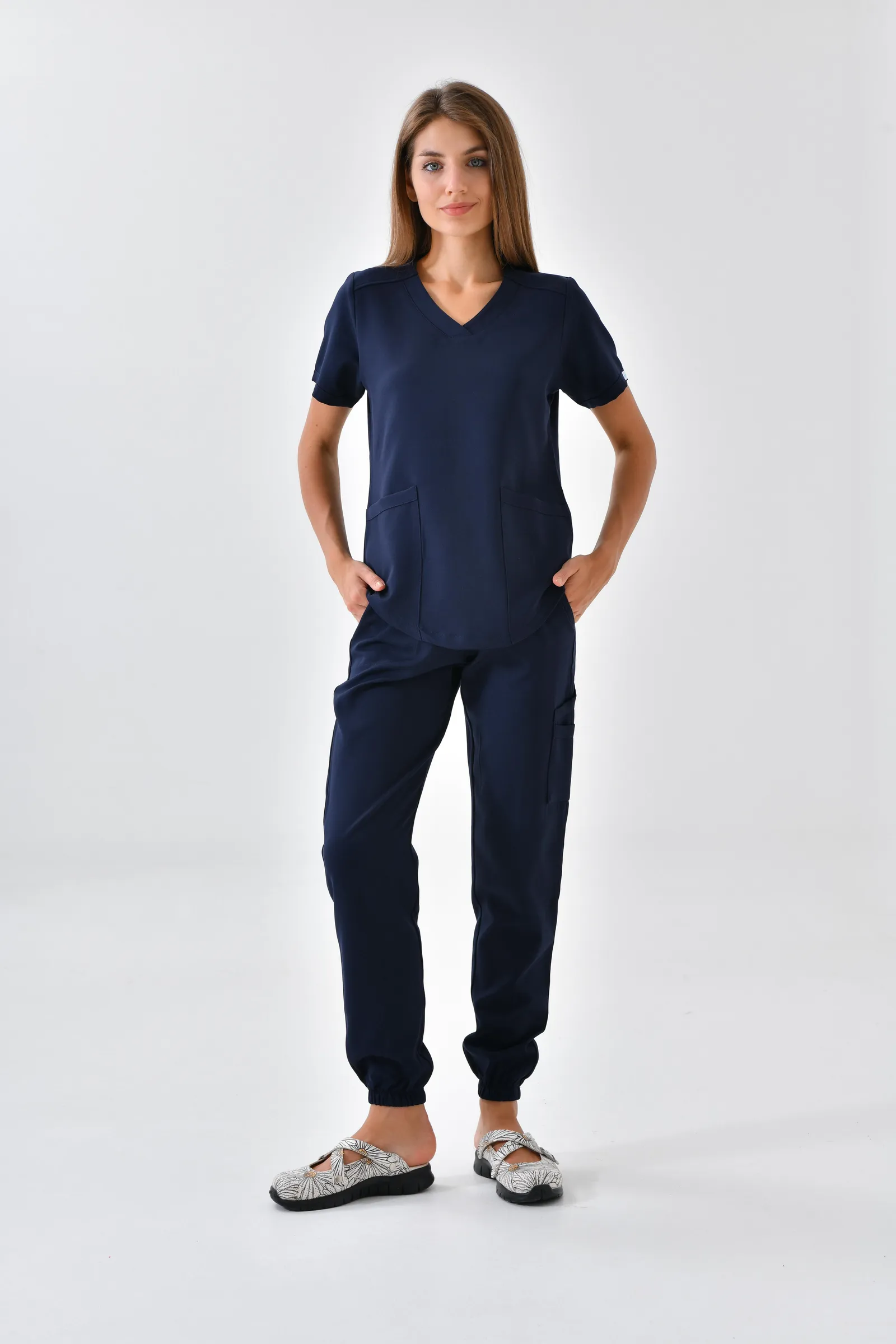
- US buyer inspecting a custom medical scrub sample from an overseas manufacturer
- Export cartons of Turkish-made scrubs with approved US fiber and country-of-origin labels
- Quality inspector checking measurements, embroidery and packing before a scrub shipment