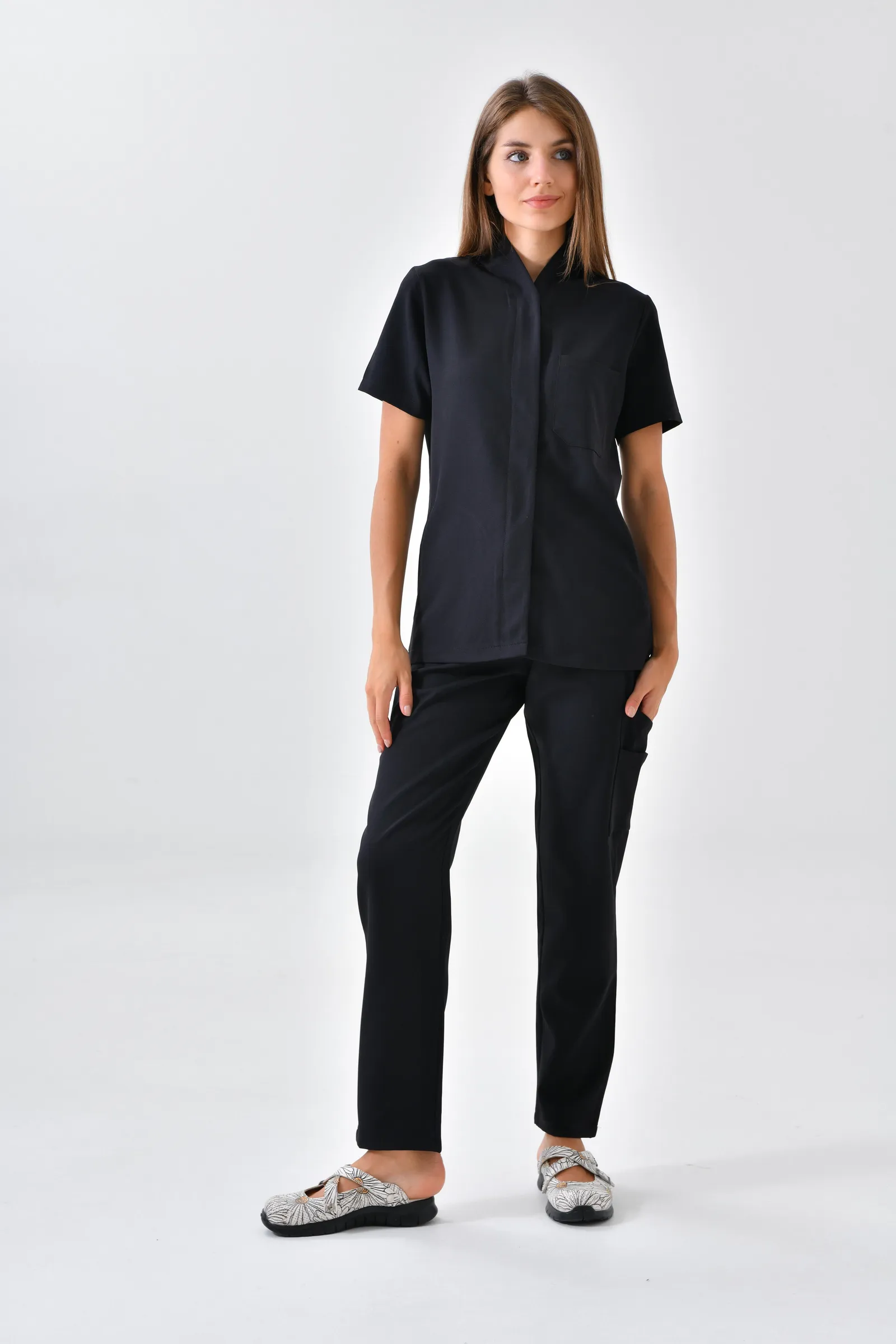
How Do You Choose a Custom Scrubs Manufacturer With a Low MOQ?
A low minimum only helps if you know what the minimum is counted against. Two suppliers can both advertise "low MOQ" and mean completely different things: one counts pieces per style, the other counts the whole purchase order. TB Uniform's minimum is 100 pieces per color and model. A sample usually takes 5–7 business days; once you approve it, production and delivery run about 4–6 weeks depending on the project.
This guide walks through the questions a procurement team should settle before asking for a quote.
What does a low minimum order mean for custom scrubs?
A 100-piece minimum per color and model lets a buyer build one focused scrub program without committing to several unrelated styles.
There is no industry definition of "low MOQ" in apparel. Before comparing suppliers, find out which unit each one uses to calculate its minimum:
- Pieces per style
- Pieces per color
- Pieces per fabric
- Pieces per gender or fit
- Pieces per size
- Total pieces across the purchase order
TB Uniform calculates its 100-piece minimum per color and model. Size distribution can be planned inside that block, but confirm the available grading and size ratios before you treat a quote as final.
One example worth working through: 100 navy scrub tops plus 100 navy scrub pants is two models, not one 200-piece order. Extra colors, contrast panels, or a separately constructed women's fit can each add another production block.
Which level of customization changes the MOQ?
Separate three sourcing models before you compare quotes: decorated stock garments, private-label production, and fully custom manufacturing.
Putting a logo on an existing blank garment is a different project from manufacturing a scrub set to your own specification. Full custom work can cover private brand and care labels, original top and trouser patterns, your choice of fabric and color, custom pocket layouts, embroidered or printed logos, branded packaging, and gender-specific or unisex fits.
TB Uniform runs private-label production with custom patterns, colors, and models, and handles printing and embroidery in-house. Fix the technical scope before you treat the MOQ or the price as settled. A different fabric, trim, or construction can force separate production planning, and that changes the math.
What should a custom scrub tech pack include?
A workable scrub tech pack defines at least 10 items before sampling: measurements, construction, materials, branding, and packaging among them.
The specification should cover:
- Front, back, and detail drawings
- Base size measurements
- Size range and grading rules
- Fabric composition and target weight
- Color reference
- Stitch and seam requirements
- Pocket dimensions and placement
- Closure, elastic, drawcord, and trim details
- Logo artwork, size, and position
- Main label, size label, care label, and packaging instructions
Also tell the manufacturer where the scrubs will be worn and how they will be laundered. A private clinic, a veterinary group, and a long-term care facility put different demands on pockets, movement, and wash cycles.
If the project reaches beyond ordinary uniforms into medical-apparel development, start with the contract manufacturing guide for medical apparel.
Which fabric specifications should buyers confirm?
A scrub fabric brief should document at least 6 variables: composition, weight, stretch, shrinkage, colorfastness, and laundering conditions.
"Soft," "stretch," and "easy care" are marketing words, not manufacturing specifications. Set measurable acceptance criteria for fiber composition, fabric weight, mechanical or elastane stretch, dimensional change after washing, colorfastness, pilling and abrasion performance, moisture management, and the wash and drying temperatures the garment must survive.
The right test plan depends on the fiber, the finish, the intended use, and your market. If an environmental or chemical requirement matters to you, name the product class, the test method, the certificate scope, and the validity period.
TB Uniform can work with project requirements tied to OEKO-TEX, GOTS, REACH, and ISO 9001, but availability has to be verified for the specific material and production scope. That is not a blanket certification claim. The OEKO-TEX scrub manufacturing guide covers restricted-substance documentation in more detail.
How should scrub sizing be validated?
Scrub sizing should pass two approvals before production: a dimensional check against the measurement chart and a practical fit assessment.
The first review measures the sample against the specified dimensions and tolerances. The second puts the garment on representative wearers and looks at movement, coverage, pocket access, rise, sleeve shape, and balance.
Do not approve a size range on the strength of a generic letter size. "M" tells you nothing without actual garment measurements, defined measurement points, and grading increments in the tech pack.
If you buy tops, trousers, and coats together, keep the measurement logic consistent across the range. The wholesale lab coats guide covers coat length, sleeves, closures, and pockets.
Which US labeling and flammability rules apply?
US-bound scrub programs should review two federal areas: textile labeling requirements and the 16 CFR Part 1610 clothing flammability standard.
The FTC explains that most covered textile products must identify fiber content, country of origin, and the manufacturer or another responsible business. Its guidance also describes when a US Registered Identification Number can replace a business name; an RN is not required simply to do business in the United States.
Care-label duties depend partly on how and to whom the garments are sold. The FTC notes a commercial-use exemption for certain products sold to institutional buyers. Whether your distribution model qualifies is worth confirming rather than assuming.
The CPSC's clothing-textile guidance covers the flammability classifications under 16 CFR Part 1610. Review the finished garment's construction and any performance claims against the applicable rules.
Official references:
- FTC textile and wool labeling guidance
- FTC Care Labeling Rule guidance
- CPSC clothing and textile guidance
Responsibilities shift with the product, the claims, the purchaser, and the channel. Official guidance is a starting point, not a substitute for the importer's own compliance adviser.
Are ordinary scrubs considered PPE or medical devices?
Under OSHA's 29 CFR 1910.1030 definition, ordinary uniforms not intended to protect against a hazard are not personal protective equipment.
Standard scrubs are not protective clothing just because healthcare staff wear them. If a garment is meant to protect against blood, body fluids, microorganisms, or another occupational hazard, its materials, construction, testing, labeling, and regulatory pathway can all change, and substantially.
The OSHA Bloodborne Pathogens standard draws the line between general work clothing and specialized protective equipment. The FDA medical gown guidance explains that surgical gowns are Class II medical devices requiring a 510(k) premarket notification.
State clearly whether you are ordering an ordinary uniform or a product that will carry a protective or medical claim. TB Uniform's standard custom-scrub information should not be read as evidence that any specific garment is PPE or an FDA-regulated device.
How do sampling and bulk approval work?
TB Uniform's standard sample stage takes about 5–7 business days after the specification and required inputs are confirmed.
A defensible approval process records tech-pack receipt, material and trim confirmation, sample construction, measurement and workmanship review, written corrections, a final approval reference, and the bulk-production authorization.
Changes after approval can affect material consumption, pattern work, price, and schedule. Keep the signed measurement table, the approved artwork, the color reference, and the approval sample itself, physical or documented.
Sample costs, shipping, and revision allowances vary by project, so confirm them each time. The wholesale scrub sample request guide explains what to send and what to examine.
How should buyers compare price and lead time?
A reliable comparison covers at least 9 cost areas rather than the quoted unit price alone.
Include fabric, trims, pattern development, sampling, labels, decoration, packaging, freight, and import costs. Then check payment terms, duties, customs brokerage, inspection, and any surcharge for extended sizing or special construction.
TB Uniform manufactures in Istanbul, Turkey, and exports to Europe and North America. Capacity can reach 50,000 pieces per month depending on the product. That figure is not a guaranteed allocation for every order; style complexity, material availability, order mix, and scheduling all affect confirmed capacity.
After sample and specification approval, production and delivery generally take 4–6 weeks. Ask whether the schedule you are quoted includes fabric procurement, bulk production, quality checks, freight, and customs clearance. Schedules that leave those out have a way of growing later.
What does the TB Uniform order process include?
The custom scrub workflow has 5 main stages: specification, quotation, sampling, written approval, and coordinated bulk production.
TB Uniform was founded in 2004 and produces in Istanbul, Turkey. For a custom scrub inquiry, send the intended model, quantity by color, estimated size distribution, fabric requirements, branding files, destination, and requested delivery date.
After technical review, both sides align on material, pattern, sample, labels, decoration, packaging, commercial terms, and the production schedule. The 100-piece minimum applies per color and model.
Current unit prices, sample charges, payment terms, freight, duties, and size-based surcharges all require a project-specific quote. The fastest route is to send the tech pack, quantity matrix, destination, and required compliance documents together through the quote request page.
Frequently asked questions
What is TB Uniform's minimum order for custom scrubs?
100 pieces per color and model. A scrub top and a scrub trouser are normally separate models, even when ordered as a matching set. Provide quantities by style, color, and size so the production structure can be confirmed before quotation.
Can different sizes be included within the 100-piece MOQ?
Yes, a size distribution can be planned within the 100-piece color-and-model block, subject to pattern availability and project confirmation. Submit the expected ratio for every size, including extended sizes, so grading, material consumption, and cutting efficiency can be assessed before commercial terms are confirmed.
How long does a custom scrub sample take?
Generally 5–7 business days after the technical specification, materials, artwork, and other inputs are confirmed. Shipping time is separate unless expressly included. Complex pattern development, unavailable fabrics, multiple embroidery trials, or requested revisions can extend the process.
How long does bulk custom scrub production take?
Production and delivery generally take 4–6 weeks after sample and specification approval. The final schedule depends on fabric availability, order volume, model complexity, branding, packaging, freight method, and production planning. Get a written calendar with approval, production, dispatch, and arrival milestones.
Can TB Uniform add private labels and embroidered logos?
Yes. Private labels, custom patterns, colors, and models are supported, with printing and embroidery handled in-house. Provide vector artwork, logo dimensions, placement instructions, color references, label content, and packaging requirements. Trademark or brand artwork must come with the necessary usage authorization.
Are TB Uniform custom scrubs certified as PPE?
Not automatically. Ordinary scrubs should not be presented as PPE unless the finished product has been designed, tested, documented, and classified for the claimed protective purpose. Requirements involving OEKO-TEX, ISO 9001, GOTS, or REACH must likewise be verified for the specific material, certificate scope, and project.
Recommended image alt texts
- Custom navy scrub set with embroidered clinic logo on a mannequin
- Tech pack drawing showing scrub top measurement points and pocket placement
- Scrub fabric swatches in a sample book with weight and composition labels
- Production line sewing scrub tops at the TB Uniform facility in Istanbul
- Approval sample of a scrub trouser with signed measurement table