Embroidered Scrubs for Hospital Staff: An Ordering Guide
An embroidered scrub should be approved as one complete combination: garment, artwork, placement, size, and laundering method. Treat it that way from the first sample onward and most downstream problems never appear. TB Uniform manufactures custom embroidery programs with a minimum order of 100 pieces per color and style. A sample typically takes 5 to 7 business days; production and delivery follow within 4 to 6 weeks of final approval.
What can be embroidered on hospital scrubs?
A hospital embroidery program usually identifies three things: the organization, the employee or role, and the approved clinical department.
The most common layout puts the hospital logo on one chest side and a department or role on the other. Where hospital policy allows it, individual names and credentials can be added as well.
Someone has to own the decision about what information is actually necessary. Stitching every credential and department name onto the garment produces long text lines, inconsistent abbreviations, and a harder replacement process later.
A workable embroidery policy defines three things up front:
- the approved organization logo,
- which names, roles, and credentials are permitted,
- exact placement and text hierarchy.
The policy should also settle how the program handles name changes, credential updates, staff transfers, and garments that cannot be reassigned. These decisions belong on paper before anyone submits employee data.
What artwork does the embroidery supplier need?
Production embroidery needs a controlled logo file, finished dimensions, thread colors, a stitch plan, and an approved garment location.
A vector file preserves the geometry of the original logo, but no embroidery machine sews a vector file. The image first goes through digitization, which converts it into stitch types, directions, densities, and sequences.
That digitized file has to cope with small lettering, enclosed shapes, outlines, gradients, and the specific fabric underneath. Details that read cleanly on screen can merge or distort once rendered in thread.
The artwork record should capture:
- the logo file and its revision date,
- finished width and height,
- approved thread references,
- placement measurements,
- who owns the digitized embroidery file.
Ask directly whether digitization fees and file access are included in the quote. Ownership and future use of the stitch file should be documented, not assumed.
Where should the embroidery be placed?
Placement has to respect pockets, badge access, garment movement, patient-facing visibility, and comfort across a full clinical shift.
Left chest, right chest, sleeve, and upper back are the usual candidates. The right choice depends on the neckline, pocket layout, seams, ID badge position, and hospital policy.
Measure chest placements from fixed garment reference points. "Above the pocket" stops being repeatable the moment pocket dimensions or garment sizes change. The supplier should state whether placement is held at a constant distance from the neckline, armhole, center front, or pocket edge.
Large, dense designs can stiffen lightweight fabric, and backing material plus stitch density can change how the inside surface feels against skin. Wear and wash the sample before approving bulk production.
Lab coats, jackets, and scrub tops are constructed differently, so each garment type needs its own placement review.
How should names and credentials be formatted?
One hospital-wide naming standard should govern capitalization, punctuation, credential order, line count, and maximum embroidery width.
Text collected from employees arrives with inconsistent spelling and abbreviations. Whether a line reads "Jordan Lee, RN" or "Jordan Lee RN" is a decision for the hospital, not for the sewing operator.
Structure the data file with separate fields for:
- employee or display name,
- approved credentials,
- department or role.
A final proof goes back to the hospital before stitching begins, and the person signing it off needs the authority to resolve spelling and credential questions on the spot.
Send only the data the garments require. The hospital should also define secure transfer, access, retention, correction, and deletion procedures for employee information; the manufacturer has no use for unrelated personnel records.
How does the 100-piece MOQ apply to embroidered scrubs?
The minimum stays at 100 pieces per color and style. Sizes and approved employee embroidery can vary freely within that quantity.
A navy V-neck top is one color-and-style variant. The navy pant is a separate style. A ceil blue top is a separate color variant.
| Order | MOQ result |
|---|---|
| 100 navy tops with one hospital logo | Meets MOQ |
| 100 navy tops with approved staff names | Meets MOQ |
| 50 navy and 50 ceil blue tops | Does not meet MOQ per color |
| 100 tops and 100 pants in navy | Meets MOQ for both styles |
Multiple sizes can be combined inside the 100 pieces, and employee names can be assigned through a controlled production list. Personalization does add work: more proofing, more sorting, more replacements to manage.
List every distinct logo, department, and placement as a separate embroidery configuration before pricing. The base MOQ itself stays tied to color and style.
What should be approved on the sample?
The 5-to-7-business-day sample confirms six things: garment fit, logo shape, dimensions, color, placement, and behavior in the wash.
A digital rendering cannot show puckering, backing, thread texture, or how the logo sits on a body in motion. Inspect the physical embroidered sample.
The review should confirm:
- correct artwork and text,
- finished width, height, and position,
- stable appearance after the intended care process.
Have clinical staff wear it. They will notice whether the embroidery rubs, restricts stretch, blocks a pocket, or collides with an ID badge. If names and credentials will use a different lettering style, sample that text too.
Record every approved element in the garment specification. Once approval is complete, production and delivery normally take 4 to 6 weeks.
How should embroidery be tested for laundering?
Test with the intended wash and drying process, because thread, backing, fabric, and color each respond to care in their own way.
The CDC's healthcare laundry guidance counts uniforms and scrub suits among healthcare textiles, and facilities that require uniforms should arrange laundering or provide task-appropriate cleaning guidance.
A care test looks for puckering, thread damage, color transfer, distortion, and logo legibility. Define the method and acceptance criteria before production starts; no supplier can honestly promise a universal wash count without a matching test protocol.
If the garments will be industrially laundered, a household wash sample proves little. Temperature, chemistry, drying, pressing, and mechanical action all differ.
The bulk hospital scrubs guide covers how fabric selection and a facility's laundering policy interact.
Does embroidery affect certification?
A certified base fabric does not automatically make the finished embroidered scrub certified under the same product scope.
OEKO-TEX STANDARD 100 covers harmful-substance testing of defined textile products and their components. If the finished article is to be certified, the relevant threads, accessories, and additions must fall within the applicable scope.
Verify the certificate holder, number, validity, product class, and article description. Embroidery thread, backing, transfers, and labels may all need to be considered.
The standard says nothing about whether an embroidered scrub is antimicrobial, qualifies as personal protective equipment, or survives a specific number of industrial washes. Each of those claims needs its own evidence.
Legal fiber, care, and origin labels remain mandatory. Decorative embroidery does not substitute for the information described in the FTC's apparel labeling guidance.
Are embroidered scrubs considered PPE?
Embroidered scrubs are ordinarily work uniforms. PPE must provide verified protection against a hazard identified in the employer's assessment.
A hospital logo does not turn a scrub into a barrier against blood, body fluids, or infectious material. OSHA's Bloodborne Pathogens guidance points to task-appropriate PPE: gloves, gowns, masks, eye protection, face shields.
Where a garment does carry a verified protective function, embroidery cannot be added casually. Needle penetration, backing, or placement could compromise the assessed construction, so the hospital should identify approved decoration zones and obtain a technical review first.
Keep routine embroidered scrubs and protective gowns as separate categories in the hospital catalog.
How should personalized garments be distributed?
Personalized distribution runs on one reconciled file linking employee, approved text, garment style, size, quantity, and delivery location.
Compare the embroidery list against the size matrix before production. A mismatch puts the right name on the wrong garment, or ships the right item to the wrong facility.
Carton and internal packing labels can identify department, location, style, and size. Specify individual employee packaging only when the program genuinely needs it.
TB Uniform supplies bulk garments but does not operate a US employee ordering portal, direct-to-home fulfillment system, or hospital allowance platform. Those functions sit with the buyer or a separately appointed provider.
The hospital uniform program supplier guide explains how manufacturing, ordering, fulfillment, and laundry roles divide.
How are embroidered scrub reorders managed?
A reliable reorder references the approved garment revision, size, logo file, digitized stitch file, placement, thread colors, and employee text proof.
Names and credentials make "same as last order" a risky instruction. Submit a controlled list instead, showing new garments, replacements, transfers, and text changes.
Reorders remain subject to 100 pieces per color and style. Hospitals can bundle employee changes into scheduled production windows while keeping the personalization data separate.
The garments are manufactured in Istanbul and exported to North America. There is no US factory, office, warehouse, local inventory, same-day embroidery service, or domestic return address. Immediate replacements have to come from hospital-held blank or finished stock, following the facility's approved process.
How should hospitals choose an embroidery supplier?
A defensible choice reviews eight areas: garment fit, digitization, sampling, data control, wash performance, MOQ, delivery, and reorder records.
Treat embroidered scrubs for hospital staff as a controlled uniform system rather than a decoration line item. The lowest stitch price often excludes digitization, individual proofs, sorting, packaging, freight, or correction procedures.
Before production, the hospital should hold the approved garment sample, embroidery sample, artwork revision, thread references, placement specification, employee list, size matrix, and written delivery terms.
Broader logo-development criteria appear in the custom logo workwear guide.
For a sample and quote, contact TB Uniform.
Frequently Asked Questions
What is the MOQ for embroidered hospital scrubs?
The minimum order is 100 pieces per color and style. Multiple sizes and approved employee embroidery details can be combined within one consistent base variant. Different colors and styles count separately, and every logo configuration should be identified before pricing and production planning.
How long do embroidered scrubs take to produce?
A physical sample typically takes 5 to 7 business days once garment specifications and usable artwork are complete. After sample and order approval, production and delivery normally take 4 to 6 weeks. Quantity, personalization, material availability, freight, customs, and receiving arrangements all affect the confirmed schedule.
Can employee names and credentials be embroidered?
Yes. Names, credentials, roles, and departments can be embroidered under a hospital-approved format. The hospital should verify spelling, punctuation, credential order, and privacy controls before production, and a reconciled file must connect each approved text entry to the correct garment style, size, quantity, and location.
Is embroidery or printing better for scrub logos?
It depends on the artwork, fabric, logo size, care process, and the finish you want. Embroidery gives a textured, durable look but can stiffen lightweight fabric. Printing handles larger or more detailed graphics. Test either method on the actual garment before bulk production.
Does embroidery make scrubs into PPE?
No. Embroidery provides identification or branding; it creates no protection against blood, body fluids, chemicals, or infectious hazards. If a garment already has a protective function, decoration requires technical review, because needle penetration, backing, or placement could affect the verified construction.
Is immediate US embroidery or replacement service available?
No. Scrubs are manufactured and embroidered in Istanbul, then exported to North America. There is no US factory, office, warehouse, local inventory, same-day embroidery service, or domestic return address. Hospitals should hold planned replacement stock or appoint a verified domestic provider for urgent needs.
Alt Texts
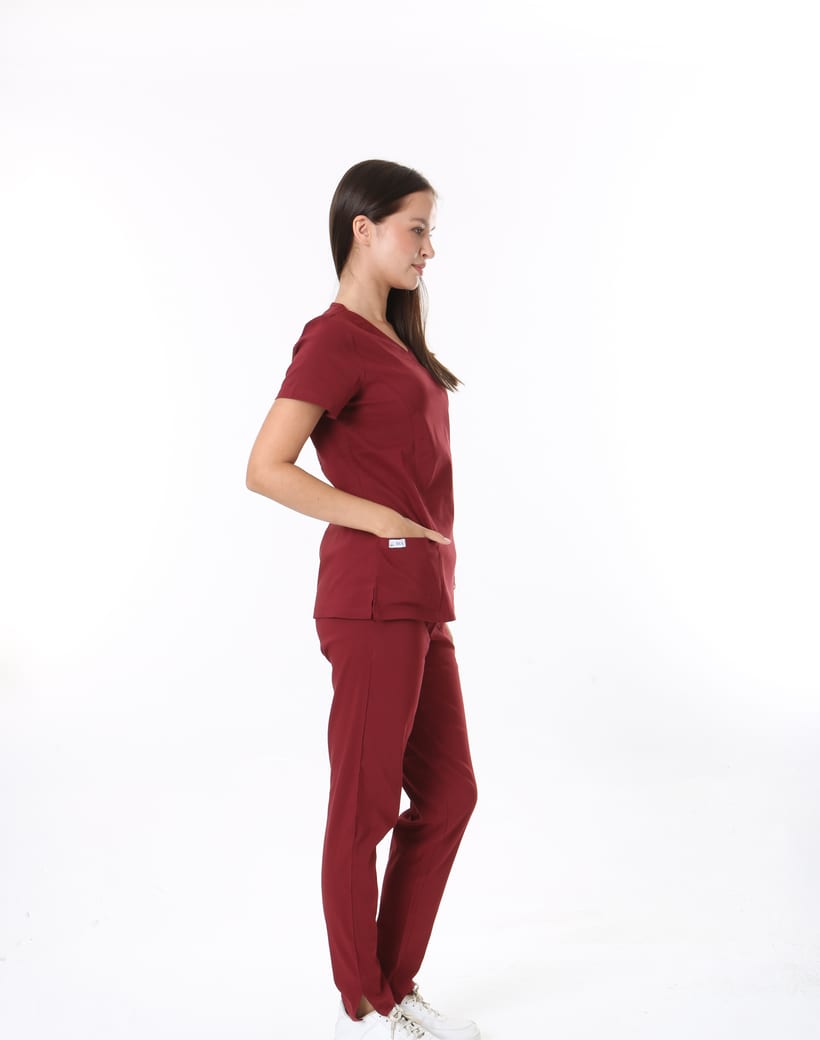
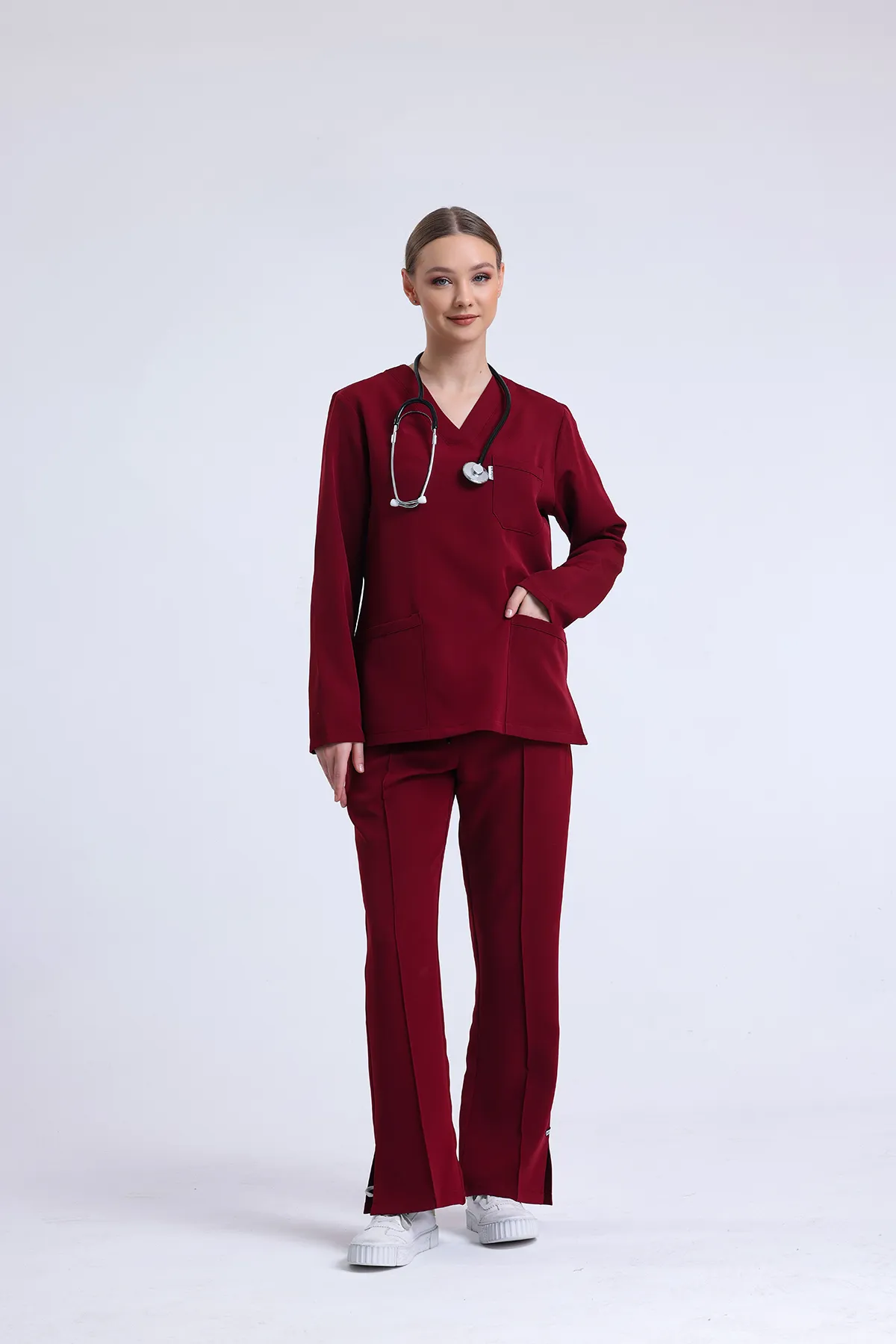
- Embroidered hospital scrub sample with approved chest-logo placement
- Staff names and credentials organized in a controlled embroidery data sheet
- Buyer measuring logo width and distance from a scrub pocket
- Personalized hospital scrubs packed by employee and facility for export