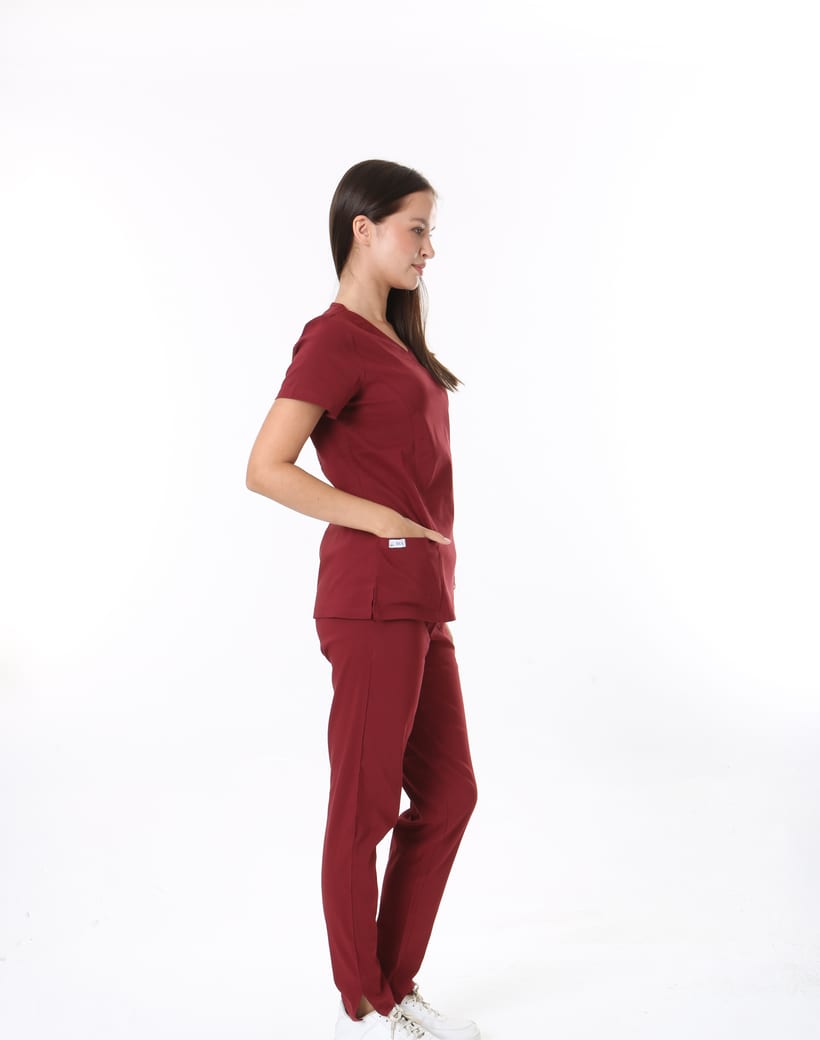
Bulk Scrubs for Hospitals: A Practical Sourcing Guide
A bulk scrub order stands or falls on what gets approved before production: the style, the color, the fabric, the size matrix, and a physical sample. TB Uniform manufactures custom scrub programs with a minimum order of 100 pieces per color and style. Samples typically take 5 to 7 business days; production and delivery follow in 4 to 6 weeks once the order is approved.
What should a hospital define before ordering bulk scrubs?
A complete scrub specification pins down at least six elements: style, color, fabric, size range, logo treatment, and laundering method.
"500 blue scrubs" is not a specification. Does the quantity mean tops, pants, or complete sets? Which pocket layout, neckline, rise, and inseam? Gender-specific grading or unisex? Each open question becomes a production decision someone else will make for you.
The initial specification should settle three areas:
- Garment design: top and pant styles, pockets, closures, and fit.
- Textile requirements: fiber content, fabric weight, color, stretch, and care instructions.
- Program details: sizes, department colors, logo placement, labels, and packaging.
Decide on the laundering process before you choose fabric, not after. A material that performs well in household washing can behave differently under institutional processing, so the approved sample should be evaluated under the care conditions the facility actually plans to use.
How does the 100-piece minimum order work?
The minimum is 100 pieces per color-and-style combination; multiple sizes can be mixed freely within one consistent variant.
A navy V-neck top is one variant. The matching navy pant is a second style, even when both use the same fabric. A ceil blue version of the top is a third variant.
| Order configuration | Separate variants | MOQ result |
|---|---|---|
| 100 navy V-neck tops in multiple sizes | 1 | Meets MOQ |
| 50 navy and 50 ceil blue tops | 2 | Does not meet MOQ per color |
| 100 navy tops and 100 navy pants | 2 | Meets MOQ for both styles |
| 200 identical tops divided among facilities | 1 | Meets MOQ |
A health system can pool demand from several facilities as long as the garment specification stays identical. The finished goods can then be packed by hospital, department, or size without touching the underlying style.
The wholesale scrub MOQ guide covers the purchasing framework in more detail.
How should hospitals plan scrub sizes?
A reliable size matrix comes from employee measurements or fit trials, not from splitting quantities evenly across an assumed range.
Equal quantities from XS through 3XL rarely match how a real workforce is built. Pull the matrix from current staff data instead, and run a fit set so employees can try the proposed pattern before procurement locks the distribution.
Worth documenting per participating employee:
- selected top and pant size,
- regular, petite, or tall length where the style supports it,
- the facility or department the quantity is assigned to.
Keep the approved measurement chart attached to the item number. "Medium" means different things across suppliers and patterns, and a revised garment means a revised chart. Treat that as a version change.
The bulk scrub sizing guide walks through the planning steps.
Should departments use different scrub colors?
Department colors work only when every approved shade has one documented owner, one garment specification, and one replacement rule.
Color coding helps staff, patients, and visitors read clinical roles at a glance. It also multiplies production variants and the inventory the health system has to carry, so every added color needs to earn its place.
A color matrix should list department, approved color reference, top style, pant style, logo, and effective date. Avoid describing similar shades as just "blue" or "green". A physical fabric reference beats an uncalibrated screen.
When two departments run the same style in different colors, each color must reach the 100-piece minimum on its own. Small departments can sometimes share a base color and use a separate approved identifier, provided the distinction stays legible for patients and employees.
See color-coded scrubs by hospital department for a full program structure.
Are ordinary scrubs personal protective equipment?
Standard scrubs are work uniforms. They are not automatic protection against blood, body fluids, chemicals, or other occupational hazards.
Staff identification and personal protective equipment are separate categories, and the purchase specification should keep them separate. OSHA's Bloodborne Pathogens resources list gloves, gowns, masks, eye protection, and face shields as the barriers used against infectious exposure.
Calling a fabric fluid resistant or antimicrobial does not make the garment protective. The employer must assess the task and provide appropriate PPE wherever exposure is reasonably anticipated. CDC guidance on protective clothing makes the same point: start from a risk assessment, and never assume a fluid-resistant garment provides adequate protection.
The specification should therefore distinguish:
- routine scrub uniforms,
- isolation or surgical protective apparel,
- other task-specific PPE.
That separation keeps a uniform claim from being mistaken for verified protective performance.
How should fabric and certification claims be checked?
A valid textile claim identifies the covered article, the certificate holder, the product class, the components, and the current certificate or test status.
OEKO-TEX STANDARD 100 tests defined textiles for harmful substances. Per the official STANDARD 100 description, a certified article includes the relevant threads, buttons, and accessories within its scope.
A certified fabric does not automatically make the finished embroidered scrub a certified article. Check whether the documentation covers the base textile, the completed garment, or both. Embroidery thread, transfers, zippers, and other additions can change what the certificate actually covers.
The other common credentials each answer a different question. ISO 9001 addresses an organization's quality management system. GOTS covers certified organic natural fibers and their processing. REACH is the European Union's chemicals framework. None of them, on its own, proves that a scrub is PPE, antimicrobial, or rated for a specified number of industrial washes.
How are samples, logos, and production approved?
The 5-to-7-business-day sample becomes the physical reference for fit, construction, color, embroidery, and later production inspection.
Sampling starts once the buyer supplies usable artwork and a complete garment specification. Embroidery and printing run inside the manufacturer's own production workflow; logo width, placement, thread or print color, and care compatibility should all be documented against the sample.
Have clinical users wear-test it: movement, pocket access, sitting comfort, sleeve opening, pant rise, length. Record every approved change in writing rather than relying on a verbal request or a single photograph.
After sample and order approval, production and delivery usually take 4 to 6 weeks. Monthly capacity reaches up to 50,000 pieces depending on the product group, but the actual schedule must be confirmed for the selected fabric, quantity, and customization.
How should a hospital manage distribution and reorders?
A controlled uniform program gives each scrub variant one owner, one item record, and one approved size matrix.
Medline's discussion of healthcare uniform programs names fragmented ownership and limited purchasing visibility as recurring health-system problems. A central program record keeps departments from quietly changing styles, colors, or suppliers on their own.
Each approved variant needs:
- a unique item and revision number,
- its color, fabric, measurement chart, and logo file,
- order history and quantities by facility.
Reorders remain subject to production minimums, so scheduled ordering windows that consolidate new hires, replacement cycles, and multiple campuses tend to work better than ad hoc purchases. A retained production sample gives you a physical benchmark, though fabric lots may still show minor color variation.
The hospital uniform program guide covers the broader operating model.
What laundering decisions belong in the contract?
Before the first scrub set goes out, the hospital must assign responsibility for clean inventory, soiled garments, contamination events, and validated laundering.
The CDC's healthcare laundry guidance counts uniforms and scrub suits among healthcare textiles, and advises facilities that require uniforms to provide laundering arrangements or employee cleaning guidance suited to the work performed.
Once a garment functions as PPE, the rules change: employer-controlled PPE must be provided, cleaned, repaired, replaced, or disposed of as OSHA requires. Ordinary scrubs should never be presented as a substitute.
One boundary to note: the manufacturer supplies and sells garments but does not provide rental, laundry, pickup, or hospital distribution services in the United States. Those operating processes are the buyer's to establish.
Where are the hospital scrubs manufactured and shipped from?
Orders are manufactured in Istanbul and exported to North America, with no US factory, office, warehouse, local stock, or same-day replacement service.
The production facility is in Istanbul, Turkey. When comparing suppliers, US hospitals should factor in international freight, import responsibilities, receiving procedures, and internal distribution.
A 4-to-6-week production-and-delivery window after approval suits planned programs, not urgent local replenishment. If your facility needs immediate single-piece replacements, hold internal reserve stock or work with a supplier that maintains verified US inventory.
A complete quote should state the delivery term, ship-to location, package labeling, document responsibilities, and the approved production timeline.
How should hospitals choose a bulk scrub supplier?
A defensible supplier decision compares seven items: sample, specification, MOQ, capacity, certification scope, delivery responsibility, and reorder process.
Evaluate bulk scrubs as an operating program, not a one-time garment purchase. The lowest unit price may leave out sampling, custom labeling, distribution, laundry, replacement stock, or import responsibilities.
Before approving the order, procurement should hold a signed garment specification, a physical sample, the final size matrix, valid artwork, variant quantities, and written delivery terms. Those records are what production control and later reorders are built on.
You can contact TB Uniform for a sample and quote.
Frequently Asked Questions
What is the minimum order for hospital scrubs?
The minimum order is 100 pieces per color and style. Multiple sizes may be combined within one consistent variant. Tops and pants are separate styles, while different colors are separate variants. A hospital system can consolidate identical demand from several facilities to meet the required quantity.
How long does a custom scrub order take?
A sample typically requires 5 to 7 business days after the specification and artwork are complete. Once the hospital approves the sample and order, production and delivery usually take 4 to 6 weeks. Fabric availability, order size, customization, freight, and import arrangements affect the confirmed schedule.
Can hospital departments order different scrub colors?
Yes, but each color-and-style combination must meet the 100-piece minimum. Procurement should assign every color to a documented department and keep a physical color reference. Adding many colors increases inventory complexity, so small departments may need to combine ordering windows or use another approved identifier.
Are hospital scrubs considered PPE?
Ordinary scrubs are generally work uniforms and do not automatically protect against blood, body fluids, chemicals, or infectious hazards. When a task requires PPE, the employer must select and provide equipment with the appropriate verified protection. Marketing terms such as fluid resistant or antimicrobial do not independently establish OSHA compliance.
Can logos be embroidered on bulk scrubs?
Yes. Embroidery and printing can be incorporated into production. The hospital should approve artwork, dimensions, location, thread or print color, and laundering compatibility on the physical sample. Different logos or placements may create separate production variants and should be identified before quantity and price calculations.
Does the supplier keep scrub inventory in the United States?
No. The garments are manufactured in Istanbul and exported to North America. There is no US factory, office, warehouse, local stock, same-day service, or domestic return location. Hospitals should plan freight, import responsibilities, receiving, reserve inventory, and internal distribution before approving a program.
Alt Texts
- Hospital scrub tops and pants organized by department color and size
- Clinical team evaluating a physical scrub fit sample before bulk production
- Size matrix and item records for a multi-facility hospital uniform program
- Labeled cartons of custom scrubs prepared for export to North America