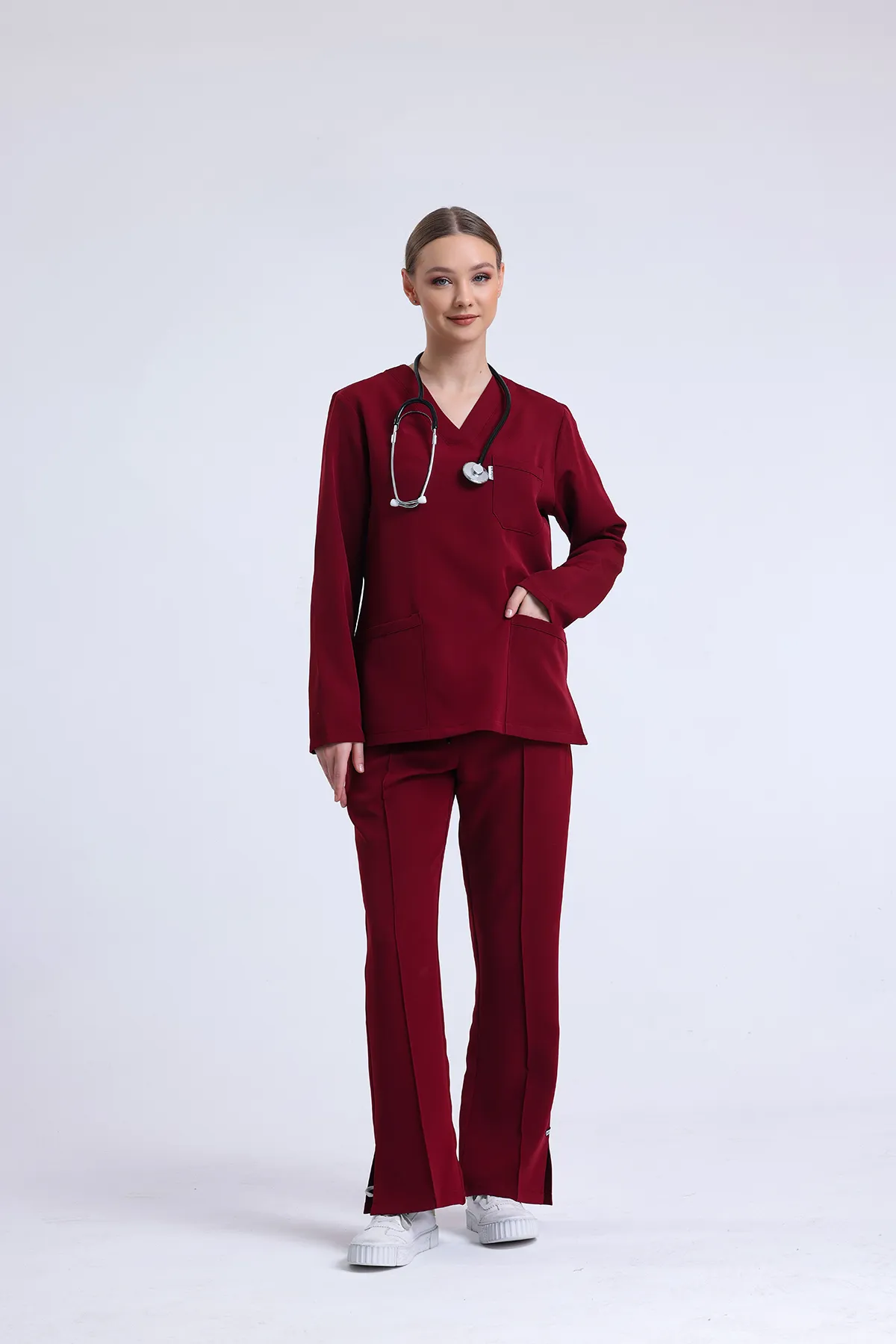
Hospital Uniform Program Supplier Selection Guide
Before you score any supplier, pin down what "program" means in each proposal. The word can cover anything from cut-and-sew manufacturing to a full managed service with laundry routes. TB Uniform manufactures custom garments in Istanbul with a 100-piece minimum per color and style, ships samples in 5 to 7 business days, and typically completes production and delivery within 4 to 6 weeks after approval. Whether that model fits depends on which program functions your hospital expects the supplier to own.
What services can a hospital uniform program include?
A full uniform program covers eight functions: design, manufacturing, sizing, ordering, branding, distribution, laundering, and replacement management.
Few suppliers cover all eight. A manufacturer may develop and produce the garments while the hospital keeps employee ordering and laundry in house. A rental provider bundles garments, scheduled service, laundering, repair, and replacement into one contract. A stock distributor runs a purchasing portal and ships quickly from existing inventory.
Map every function to an owner before the RFP goes out:
| Program function | Possible owner |
|---|---|
| Garment specification | Hospital and manufacturer |
| Bulk production | Manufacturer |
| Employee size collection | Hospital or program administrator |
| Ordering portal | Hospital, distributor, or technology provider |
| Location distribution | Hospital or fulfillment provider |
| Laundry and repair | Hospital or textile service |
| Inventory reporting | Procurement or program platform |
| Employee replacement | Hospital stock or contracted provider |
Score suppliers only on services they actually offered. The RFP should separate the garment requirement from the program-administration requirement.
Which garments belong in the approved catalog?
An approved catalog ties one controlled style, color, logo, and care process to each clinical or operational role.
A program may cover scrub tops, scrub pants, lab coats, doctor coats, warm-up jackets, surgical sets, and uniforms for technical, dietary, environmental, and reception staff.
Resist giving departments free access to every style and color. A role-based catalog limits unauthorized variation and keeps replacement planning predictable.
Each approved item needs:
- a unique item and revision number,
- a fabric, color, and measurement chart,
- a defined logo and department assignment.
Approve color against a physical textile reference, not a name. Navy, royal, and ceil blue mean different shades at different suppliers. The department scrub color guide shows how to control role assignments without multiplying variants.
How does the 100-piece MOQ affect a hospital program?
Each color-and-style combination needs at least 100 pieces. Sizes and participating facilities can share one variant; different styles and colors cannot be combined.
A navy V-neck top and a navy pant count as two styles. Add a ceil blue top and you have a third variant. The 100-piece minimum applies to each one separately.
Health systems can pool identical demand across hospitals, clinics, and departments. Cartons can then be labeled by facility and size while the underlying product stays the same.
The opening order should distinguish three buckets:
- initial employee issue,
- a replacement and new-hire reserve,
- forecasted reorder quantities.
No universal reserve percentage fits every hospital. Staffing turnover, laundry circulation, wear, and replenishment frequency set the right level. The bulk hospital scrubs guide gives a product-level ordering framework.
What should the supplier's sample prove?
The 5-to-7-business-day sample confirms fit, measurements, fabric, construction, color, logo, labels, and compatibility with the planned care process.
A physical sample gives clinical staff and procurement one shared reference. Test it in motion: reaching, bending, sitting, pocket access, sleeve opening, pant rise, inseam, and overall coverage.
Record the approved measurements instead of trusting a size label. Medium is not a standardized dimension across brands or patterns.
The logo needs physical approval too. Embroidery width, thread color, placement, backing, and post-wash appearance often differ from the digital mockup. Printing calls for the same scrutiny of dimensions, color, texture, and care compatibility.
Once approved, the sample and the signed specification become the production references. Any change gets a new revision number so old and new garments are never mixed without documentation.
What ordering and reporting functions should be required?
A multi-facility program needs one data owner and reports that break out purchases by employee, role, department, facility, item, and date.
Medline's review of healthcare uniform program challenges lists fragmented ownership, incomplete purchasing visibility, inconsistent branding, and manual workflows as recurring problems in large health systems.
A hospital running a portal or internal ordering system should define:
- who may order and approve each item,
- whether the hospital or the employee pays,
- quantity or dollar allowances,
- refresh dates and exception rules,
- the reports procurement and finance need.
The system should show only approved role-based items, and it should log every manager override of a color, size allowance, or replacement rule.
The manufacturer described here supplies garments only. It does not run a US employee ordering portal, direct-to-home fulfillment, or hospital allowance administration. The buyer or another program provider handles those functions.
How should sizing be managed across facilities?
One approved measurement chart and a controlled fit set should govern every location using the same style.
Schedule fit sessions or circulate a complete fit set among participating facilities. Employees should pick sizes in the actual approved pattern; converting automatically from another brand's sizing invites errors.
The final matrix identifies quantities by style, size, length where applicable, department, and location. Individual names are needed only if your distribution process depends on them.
A central size record supports later replacements, but the hospital decides how to handle employee privacy and data access. The manufacturer needs production quantities, not personnel files.
The bulk scrub sizing guide covers fit sets, measurement points, and size-matrix controls.
Should a hospital buy or rent uniforms?
Purchase gives more control over custom garments, while rental can bundle clothing, pickup, laundering, repair, and replacement in one service contract.
With a purchase program, the hospital owns the garments and controls custom patterns, colors, labels, and supplier documentation. It also inherits employee issue, laundry, repair, loss, and replacement.
Rental shifts several of those operating functions to a textile service provider. UniFirst's healthcare program page shows how a US provider structures direct-purchase, managed-inventory, national-account, and rental options. Contract scope varies, so verify each promised service.
The Istanbul manufacturer sells uniforms outright. It offers no rental, laundry, pickup, managed US inventory, or domestic replacement service. When comparing the two models, normalize garment cost, circulation inventory, service charges, loss rules, contract term, and distribution labor.
What laundering responsibilities must be assigned?
The contract must name who controls clean inventory, soiled collection, contamination events, washing validation, repairs, and return to service.
The CDC's healthcare laundry guidance counts uniforms and scrub suits among healthcare textiles. CDC advises facilities that require uniforms to make laundering provisions or give employees task-appropriate infection-control and cleaning guidance.
Do not confuse ordinary scrubs with personal protective equipment. Under OSHA's Bloodborne Pathogens framework, employer-controlled PPE carries specific provision and laundering duties.
Before selecting garments, define the washing temperature, drying process, detergents, finishing, and the industrial handling the fabric must survive. Any wash-cycle, shrinkage, or colorfastness requirement needs a test method and an acceptance criterion.
A supplier's general care label does not replace the facility's infection-control policy.
How are reorders and replacements handled?
A reliable replacement process links every request to the approved style revision, size chart, color reference, logo file, and minimum order plan.
Reorders carry the same 100-piece minimum per color and style. The manufacturer does not hold finished stock just because it produced the original run.
Hospitals work around this limit with scheduled purchasing windows, internal reserve stock, or a separate domestic inventory partner. A central program can pool new-hire, size-change, and replacement demand across facilities.
Before each reorder, verify:
- current employee and reserve quantities,
- material and certification status,
- whether the pattern or label changed since the last run.
Fabric lots can vary slightly in shade. Where tops and pants must match, coordinate their production. The original physical sample stays the benchmark for construction and fit.
Where are the uniforms manufactured and shipped from?
Production is in Istanbul, with export to North America. There is no US factory, office, warehouse, local stock, or same-day replacement service.
The facility has operated since 2004 and can produce up to 50,000 pieces per month, depending on the product group. After sample and order approval, production and delivery normally take 4 to 6 weeks.
A US hospital must plan for international freight, importer-of-record responsibilities, duties, customs brokerage, receiving, and internal distribution. The quote should state the delivery term and the exact ship-to location.
This model suits planned bulk programs. A hospital that needs one-piece replacement on demand must hold its own inventory or add a provider with verified domestic stock.
How should hospitals compare program suppliers?
A defensible selection scores ten areas: garments, sample, sizing, ordering, reporting, distribution, laundry, inventory, delivery, and contract exit.
Ask every candidate to state which services are included, excluded, subcontracted, or dependent on another provider. A low garment price may leave out employee ordering, embroidery, fulfillment, laundry, import costs, and replacement inventory.
Before award, have the approved catalog, physical samples, size matrix, color policy, logo standard, laundering assignment, reporting requirements, reorder process, delivery terms, and transition plan in hand.
The hospital uniform program operations guide covers implementation after supplier selection. For a sample and quote, contact TB Uniform.
Frequently asked questions
What does a hospital uniform program supplier do?
The role varies by supplier. Services may include garment design, manufacturing, size collection, ordering technology, embroidery, distribution, laundry, repair, reporting, and replacements. List each required function and assign a responsible party; a garment manufacturer does not automatically provide a complete managed-service program.
What is the minimum order for custom hospital uniforms?
The minimum is 100 pieces per color and style. Multiple sizes and facilities can share one variant when the garment specification stays identical. Tops, pants, coats, different colors, and materially different designs count separately and should each appear as a line in the program catalog.
How long does a hospital uniform order take?
A sample typically takes 5 to 7 business days once specifications and artwork are complete. After sample and order approval, production and delivery normally take 4 to 6 weeks. Material availability, customization, quantity, freight, customs, and receiving arrangements affect the confirmed schedule.
Does the supplier offer employee ordering and US fulfillment?
No. The manufacturer supplies garments but does not operate a US employee ordering portal, allowance system, warehouse, direct-to-home fulfillment service, or domestic replacement program. Hospitals that need these functions manage them internally or contract a separate technology, distribution, or fulfillment provider.
Does the supplier rent and launder hospital uniforms?
No. The supplier manufactures and sells uniforms but does not provide rental, pickup, laundry, repair routes, or managed circulation inventory. A hospital can organize those functions internally or appoint a textile service. Compare purchase and rental proposals over the same contract and usage period.
Is immediate US replacement inventory available?
No. Uniforms are manufactured in Istanbul and exported to North America. There is no US factory, office, warehouse, local stock, same-day service, or domestic return address. Hospitals should hold appropriate reserve inventory or add a verified domestic stock provider for urgent one-piece replacements.
Alt texts
- Hospital uniform catalog organized by role, garment style, and department color
- Clinical staff using a controlled scrub fit set before program launch
- Multi-facility uniform ordering report divided by item, size, and location
- Custom hospital uniforms packed for export from Istanbul to North America