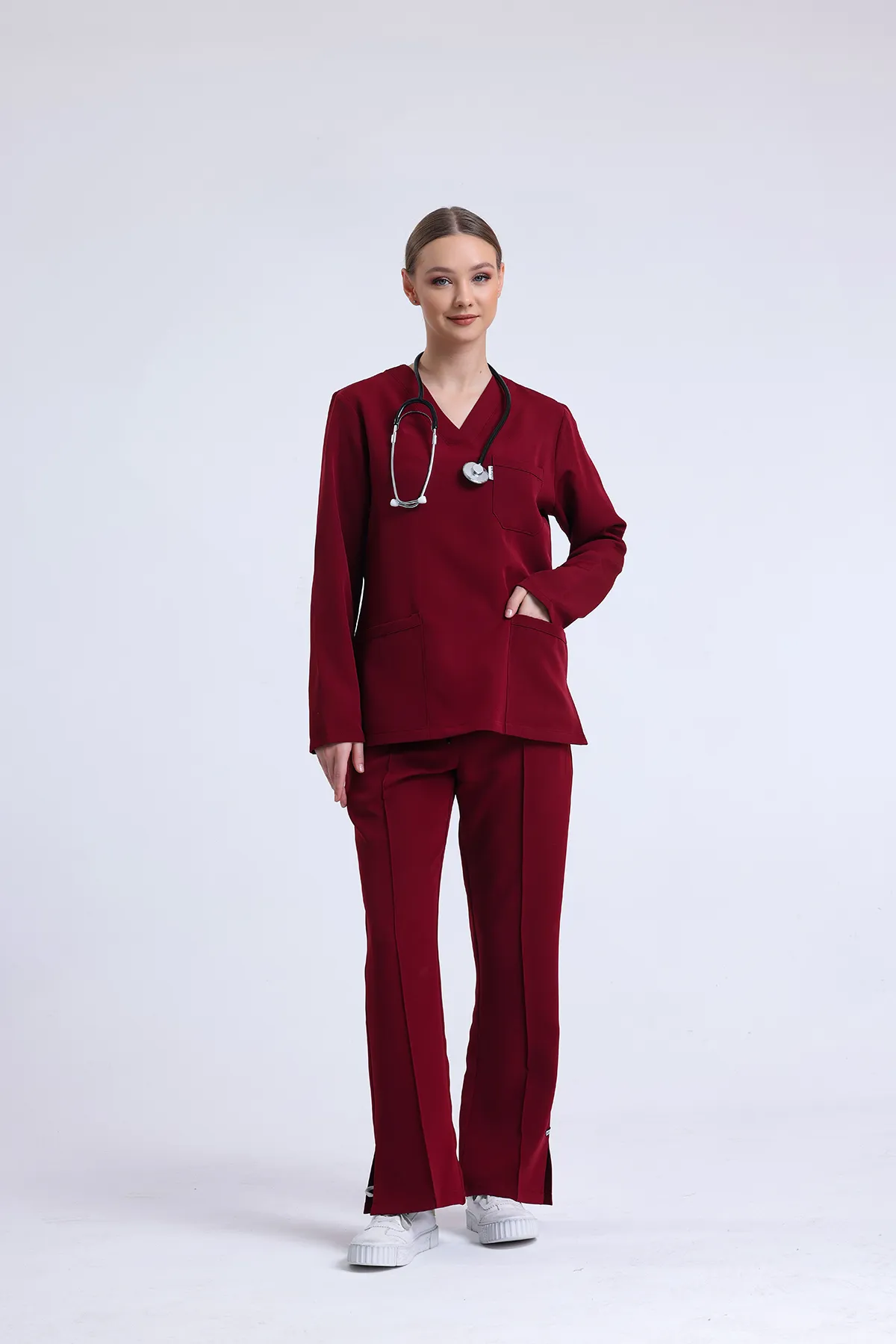
How Do You Plan an Order for Embroidered Logo Workwear?
Getting a logo embroidered onto company workwear cleanly comes down to seven decisions made before production starts: the file, colors, dimensions, placement, fabric, quantity, and care method. TB Uniform manufactures and embroiders out of its own factory in Istanbul. The minimum order is 100 pieces per color and style, a physical sample takes 5 to 7 business days, and production plus delivery typically runs 4 to 6 weeks after everything is approved.
Which Workwear Pieces Can Actually Be Embroidered?
An embroidery program can cover jackets, pants, vests, coveralls, scrub tops, and lab coats across at least six product groups.
Whether a specific spot on a garment can take embroidery depends less on preference than on construction: fabric, lining, and how accessible the area is under the machine. A chest pocket behaves differently from a lined jacket, and a narrow sleeve panel often needs a separate production step compared with an unlined scrub top.
| Product | Typical checkpoints |
|---|---|
| Work jacket | Lining, pockets, and back access |
| Work pants | Pockets, waistband, and reinforcements |
| Work vest | Chest panel, closure, and lining |
| Coverall | Chest, back, and name identification |
| Scrub top | Fabric weight, pocket, and facility logo |
| Lab coat | Chest pocket, lapel, and weave structure |
| Service uniform | Style, fabric, and visible placement |
A logo shouldn't sit across a heavy seam, a zipper, or a functional opening. On protective clothing, there's a second question on top of that: does the embroidery material and its position still line up with the garment's existing certification?
What Logo File Does Embroidery Actually Need?
Approving an embroidery run comes down to five fixed pieces of information: a vector file, color values, dimensions, placement, and quantity.
A vector file describes shapes mathematically rather than as pixels, so it scales without the quality loss you'd get from stretching a small raster image. Standard production data can be built from a suitable vector file; the exact format needed gets confirmed before the sample stage, not assumed upfront.
Procurement should have ready:
- An approved company logo
- Defined logo colors
- Target width and height
- Placement on each garment style
- Number of logos per piece
- Names or departments as variable data
- A locked spelling and naming convention
- A mapping to model and size
Very fine lines, small type, or tight letter spacing can behave differently once stitched than they do on a screen. That's a reason to check a physical logo on the actual intended fabric before committing to a full run, not just review it as a digital mockup.
Embroidery or Print: What's the Real Difference?
Embroidery works with thread and stitches; print applies ink or another coating directly to the fabric surface.
Neither technique wins outright. The right call depends on the logo itself, the fabric, how it gets laundered, the finish you want, and where it sits on the garment.
| Factor | Embroidery | |
|---|---|---|
| Surface feel | Raised, tactile thread texture | Flatter or coated, depending on method |
| Fine detail | Limited by thread and stitch build | Suitable print methods can hold fine detail |
| Small type | Needs a legibility check | Depends on print method and fabric |
| Lined garments | May need back-of-fabric access | Depends on the panel and method used |
| Color accuracy | Set by available thread colors | Controlled by the print system and fabric |
| Care | Thread, fabric, and backing checked together | Ink, fabric, and care method checked together |
| Sampling | Requires a physical embroidery test | Requires a physical print test |
Both methods can sit side by side in the same company collection. An embroidered chest logo on a jacket and a printed back graphic on a shirt aren't unusual in the same order.
How Should Logo Size Actually Be Set?
Four factors decide logo size: legibility, garment size, nearby seams, and the space actually available.
The same logo can read very differently on a small scrub top than on a full-size work jacket, which is why placement should get checked on the smallest garment in the run, not the largest.
Useful questions at approval stage:
- Does the text stay legible at normal working distance?
- Does the logo touch a pocket or seam?
- Does the placement work across every size in the run?
- Does a sleeve or collar hide part of the design?
- Does the embroidery backing sit against a sensitive contact point?
- Does the brand color stay clearly recognizable on the fabric?
- Does the application match the brand's style guide?
Different garment styles often need an adjusted logo size rather than one fixed measurement forced onto everything. Each of those variants should get its own dimension and placement documented in the tech pack, not estimated by eye.
What Happens During the 5-7 Business Day Sample?
Once style, fabric, logo, and placement are confirmed, TB Uniform can turn around an embroidered sample in 5 to 7 business days.
The sample needs to come from the actual fabric planned for the order. A test run on a similar-feeling material won't necessarily produce the same result, because weave structure, weight, and stretch all affect how a design sits.
Sample review should document:
| Check area | Question |
|---|---|
| Logo shape | Do contours and proportions match approval? |
| Color | Does the thread match what was approved? |
| Dimensions | Are width and height correct? |
| Placement | Is the distance from pocket, collar, and seam right? |
| Fabric | Does the panel pucker or ripple? |
| Backing | Is the reverse side suitable for the intended use? |
| Care | Does it hold up through the specified wash process? |
Any change to size, stitch build, or placement calls for a new sample round. Only the version approved in writing should ever serve as the reference for full production.
How Do You Handle Names and Departments?
Variable embroidery data needs at least five accurately mapped fields: name, department, style, size, and placement.
Personalization adds real overhead to quality control and sorting. Locking the name list before production starts, with a clear item-level mapping for every record, keeps that overhead from turning into rework.
A typical data record uses these columns:
- Employee name
- Job title or department
- Style code
- Product color
- Size
- Logo placement
- Spelling as it should appear in embroidery
- Packaging assignment
Late changes tend to hit embroidery or packaging data that's already been prepared, which is exactly what an internal sign-off point on names and sizes, set before production starts, is meant to prevent.
Private label programs often layer on additional brand, size, and care labels beyond the embroidered logo itself. Buying direct from the manufacturer covers what that adds to the process.
How Does the 100-Piece Minimum Actually Work?
The production minimum is 100 pieces per color and style, and different sizes can be freely distributed within that same variant.
The minimum applies to garment production, not to each individual name. A hundred identical jackets can carry a hundred different name embroideries, as long as the technical and commercial terms are confirmed in advance.
| Order | Assessment |
|---|---|
| 100 jackets, 1 color and style | Base minimum met |
| 50 jackets per color | Colors checked separately |
| 50 jackets and 50 vests | Styles checked separately |
| 100 identical jackets across sizes | Sizes can be freely distributed |
| 100 jackets with individual names | Variable data planned as its own line item |
A large back embroidery, a small chest logo, and a name line count as three separate applications, and a quote needs to spell out the count, dimensions, and placement for all three. Minimum order quantities for workwear goes deeper into how volume planning works.
What About Logos on High-Visibility Workwear?
Under ISO 20471, a logo can't improperly reduce the required area or arrangement of fluorescent and retroreflective material.
ISO 20471:2013 is the international standard setting requirements for color, retroreflection, minimum material areas, and layout on high-visibility clothing, with a published amendment from 2016. It's the standard referenced across the EU, including Germany and Austria; buyers working against ANSI/ISEA 107 in the US are looking at a related but distinct framework.
A logo on a hi-vis vest inevitably eats into available background area, so embroidery can't just be placed over retroreflective tape or certified material zones without a check first.
What actually decides the outcome:
- The certified garment model
- The smallest size affected
- The fluorescent area that remains
- Continuity of the reflective strips
- The embroidery material itself
- The intended placement
- Sign-off recorded in the product documentation
A logo placed without regard for any of this can quietly change the documented construction of a certified base garment. That's a conversation to have before production, not something to catch afterward.
Which Fabric and Chemical Documents Actually Matter?
OEKO-TEX, REACH, and ISO 9001 cover three different things: contaminants, chemical regulation, and quality management.
OEKO-TEX STANDARD 100 tests textiles for harmful substances. On an embroidered product, that scope can extend to the fabric, thread, backing, and other components, not just the base cloth.
REACH is the EU's regulation governing the registration, evaluation, authorization, and restriction of chemicals. It's relevant whenever a program is shipping into the EU, including Germany and Austria, which makes the chemical supply chain worth checking before goods move.
ISO 9001:2015 defines requirements for a quality management system. The certificate doesn't, by itself, prove that a given logo is washable or compatible with a specific piece of protective clothing.
A certificate is only as useful as the fabric, thread, and model code it's actually mapped to. Treating it as a blanket guarantee is where most gaps show up later.
Buy or Rent Embroidered Workwear?
Buying means the company owns the embroidered garments outright; a rental arrangement can bundle marking, laundering, and replacement into one contract instead.
Rental providers typically combine the garments themselves with washing, pickup, delivery, repair, and replacement. In the German and Austrian market, providers like Mewa and SALESIANER run programs built around that model.
| Factor | Buy | Rent |
|---|---|---|
| Ownership | Company owns the goods | Provider usually retains ownership |
| Logo freedom | Approved directly with the manufacturer | Depends on the rental provider's range |
| Name changes | Company handles it directly | Check the contract terms |
| Cleaning | In-house or outsourced separately | Can be included |
| Replacement | Drawn from your own stock | Can be included |
| Commitment | No rental term to manage | Contract length and cancellation terms apply |
TB Uniform manufactures, embroiders, and sells workwear. Rental, laundering, pickup, or ongoing garment care aren't part of what it offers.
How Does Production and Delivery Actually Wrap Up?
Once the sample, quantities, sizes, logo, labels, and packaging are all approved, manufacturing and delivery typically take 4 to 6 weeks.
Production and embroidery both happen at the factory in Istanbul. There's no separate branch, warehouse, or pickup point maintained elsewhere.
Monthly capacity can run up to 50,000 pieces depending on the product group, though the confirmed delivery date ultimately depends on the mix of styles, colors, embroidery variants, fabric availability, and delivery destinations involved.
Anyone ordering embroidered logo workwear is better off keeping the approved sample, the embroidery file, the size matrix, and the packaging plan together as one reference set for every reorder. Wholesale workwear procurement covers more of that sourcing process. For a sample and a quote, contact TB Uniform directly.
Frequently Asked Questions
What file do I need for an embroidered company logo?
A production-ready vector file works best. Logo colors, dimensions, placement, and quantity also need to be locked in. Small type and fine lines are worth checking physically on the intended fabric, since the approved data is what becomes the actual embroidery production file, verified again at the sample stage.
What's the minimum order for embroidered workwear?
TB Uniform's minimum is 100 pieces per color and style. Standard sizes can be freely distributed within that same variant. Different names can be planned as variable embroidery data without automatically requiring 100 pieces per name, but different colors, styles, or standalone cuts are each treated as separate production variants.
How long does an embroidered sample take?
Usually 5 to 7 business days once style, fabric, logo, size, and placement are confirmed. Review covers shape, color, dimensions, placement, fabric behavior, backing, and care performance. Any change gets a new sample round, and only the version approved in writing should serve as the reference for full production.
Can employees be identified by name?
Yes. Names, job titles, and departments can all be embroidered as variable data. That requires an approved spelling, style, size, placement, and packaging assignment for each person. Errors in the source list carry straight through to production and sorting, which is why an internally reviewed final list before production starts matters.
Can a logo be embroidered onto high-visibility workwear?
Only after a technical check. On ISO 20471 garments, the logo can't improperly change the required fluorescent and retroreflective areas or their layout. That gets verified against the certified model, especially at the smallest size, since a change outside the documented scope of the model can affect the existing conformity assessment.
Does TB Uniform offer embroidery as part of a rental service?
No. TB Uniform manufactures, embroiders, and sells workwear, but it doesn't offer rental, laundering, pickup, or ongoing garment care. Companies looking for a rental system should check logo changes, name swaps, contract length, wash procedures, repair, loss, and replacement directly in that provider's service agreement. With a purchase, the owner handles those tasks directly or through a separate partner.
Recommended Alt Text
- Embroidered company logo on a work jacket, positioned and checked next to the chest pocket
- Side-by-side comparison of embroidery and print on workwear fabric swatches
- Name embroidery on scrub tops mapped by style, size, and employee
- Workwear embroidered in Istanbul, prepared for export to Germany and Austria