Buying Restaurant Uniforms Wholesale for German and Austrian Operations
For a group ordering uniforms across restaurant locations in Germany or Austria, a single-uniform approach rarely holds up. It's more workable to plan procurement around at least six role packages: kitchen, front-of-house service, bar, host/reception, dish room, and management. On top of that, EU Regulation (EC) No 852/2004 requires anyone handling food to wear clothing that's suitable, clean, and protective where the work calls for it. A wholesale order only becomes reliable once shift counts, change frequency, sizing, laundering, personalization, and backup stock are all defined.
What uniform categories does a restaurant operation actually need?
A workable program groups staff into at least six role packages rather than issuing one uniform to everyone.
| Role area | Typical garments | Main requirement |
|---|---|---|
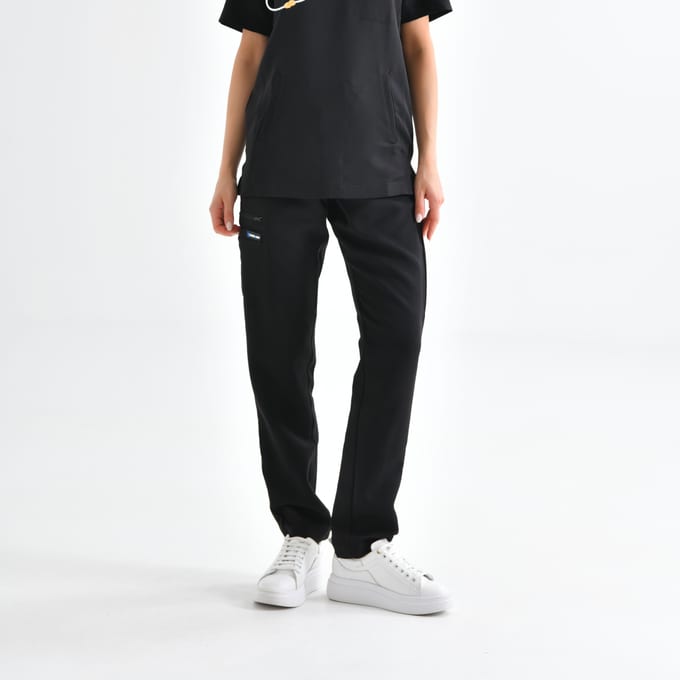
| Kitchen | Chef coat, chef pants, apron | Heat, splashes, mobility |
| Service | Shirt, blouse, polo, apron | Guest contact, comfort |
| Bar | Shirt, polo, apron | Arm movement, pockets |
| Host/reception | Blouse, shirt, jacket | Presentable silhouette |
| Dish room | Top, pants, apron | Moisture, durability |
| Management | Shirt, blouse, optional blazer | More formal presence |
Not every role needs a fully distinct design. Shared base colors, pants, or tops can be paired with different aprons and logo placements to keep the program modular. Documenting the corporate look, roles, and approved combinations in a short style guide makes reordering far easier. Corporate fashion programs for companies covers how that kind of modular collection gets built.
What does kitchen clothing need to hold up against?
Kitchen garments need to account for at least five factors: heat, liquid splashes, open flames, machinery, and hygienic changeovers.
DGUV Rule 110-003 for commercial kitchens, issued by Germany's BGN, recommends long-sleeved chef coats and pants as the preferred choice, to reduce injury from hot splashes or contact with hot surfaces, and calls for clothing that isn't quick to ignite near open flames. A chef coat's traditional cut doesn't automatically qualify it as protective clothing; the right choice follows from the actual tasks and a hazard assessment.
Worth checking before ordering:
- Sleeve and cuff shape
- How quickly a garment can be removed
- Concealed closures
- Range of motion at shoulder and back
- Pocket placement
- Behavior under heat and moisture
- Compatibility with the planned wash cycle
Loose ties, wide sleeves, or dangling accessories are a real hazard near rotating equipment. Aprons and chef coats should be evaluated together as one working system rather than as separate items.
What do EU food hygiene rules require of staff clothing?
Regulation (EC) No 852/2004 sets three baseline requirements: high personal cleanliness, suitable clean workwear, and protective clothing where necessary.
These requirements sit in Chapter VIII of Annex II to the EU food hygiene regulation. For a food business, clothing is part of the operational hygiene and self-monitoring system, not a matter of appearance alone. For a company sourcing uniforms for restaurant locations in Germany or Austria, that's the regulation your local operations team is expected to work within, not a US or Turkish equivalent.
A clothing policy typically defines:
- When clean garments get issued
- How often staff change
- What happens after visible contamination
- Where clean and worn clothing are stored
- Who manages laundering and returns
- How backup sets stay available
The regulation doesn't mandate one specific garment per role or a fixed wash temperature. Procedures and materials need to match the site's actual hygiene plan. Germany's Lebensmittelverband notes that food businesses are expected to determine their own process, staff, and product hygiene measures and back them up through HACCP-based self-checks.
How do you calculate order quantity per employee?
Quantity planning runs on at least four variables: working days, change frequency, laundry turnaround, and operational reserve.
A simple starting formula:
`Staff × sets per person + size buffer + backup stock`
If a cook needs clean clothing daily and laundry turnaround takes several days, more changeover sets are needed to cover that gap. Front-of-house staff can have a different requirement depending on their tasks and how quickly garments get soiled.
Planning should account for:
- Number of staff working at the same time
- Full-time, part-time, and seasonal workers
- Mid-shift changes
- Time between drop-off and return
- New hires
- Damage and size changes
- Events that bring in extra staff
- Reserve stock for common sizes
Reserve stock is planned centrally by size and style. Real staffing and changeover numbers give a more accurate figure than a flat reserve percentage applied across the board.
Which fabrics work for kitchen and service roles?
A fabric comparison should cover at least six criteria: wearing comfort, opacity, shape retention, stain behavior, care, and fit for the role.
Cotton blends often balance comfort and shape retention. Polyester content can speed up drying and simplify care. Stretch can improve mobility for bar and service staff, but it needs to be checked against the intended wash process.
| Criterion | Kitchen | Service |
|---|---|---|
| Wearing comfort | High priority near heat | Important on long shifts |
| Opacity | Especially for light colors | Relevant for shirts and blouses |
| Mobility | Shoulders, back, and knees | Reaching, carrying, walking |
| Stain behavior | Grease and food | Drinks and food |
| Shape retention | After frequent washing | For a presentable look |
| Branding | Account for the heat zone | Visibility with guests |
Stain-resistant or easy-care claims need a technical explanation and a check against a real sample. A finish shouldn't be treated as equivalent to a protective function without evidence.
Which apron styles fit which roles?
Restaurant operations typically compare four apron styles: waist apron, bistro apron, bib apron, and functional kitchen apron.
A waist apron offers freedom of movement and works well for service or bar staff. A longer bistro apron reads as more formal. A bib apron covers more of the torso and often suits kitchen, café, or craft-driven concepts.
Worth checking:
- Length and walking clearance
- Number and position of pockets
- Adjustability
- Ties versus other closures
- Print or embroidery
- Wash and shape behavior
- Contact with hot surfaces or machinery
Long ties need to be worn so they can't catch on equipment or furniture. Pockets should be sized around the actual order pads, tools, or devices staff carry, not just for appearance.
How should sizing be planned for seasonal teams?
Reliable size planning takes at least two steps: matching a size chart and fitting a representative size run.
Casual sizing isn't precise enough, especially across women's, men's, and unisex cuts. Tops and bottoms should be orderable in separate sizes. Seasonal staff go through the same documented process as year-round employees.
A size list typically includes:
- Anonymized employee code
- Role area
- Top style and size
- Pant style and size
- Apron style
- Quantity
- Name or role label
- Fitting confirmation
Personalized names get applied only after sizing is confirmed. Ordering a workwear sample walks through how sample and size-run approvals work.
How should restaurant uniforms be personalized?
Branding works best split across three layers: company logo, employee name, and role labels.
Embroidery generally suits small logos on chef coats, shirts, polos, and aprons, though very fine text or large filled areas may need technical adjustments. Print tends to work better for larger or multi-color designs.
Logo, fabric, and care process get sampled together. On lightweight blouses or stretch fabrics, it's worth checking whether a dense stitch count distorts the fabric. On aprons, the decoration shouldn't interfere with pockets or the tie system.
TB Uniform runs printing and embroidery in-house, which allows position, color, and finish to be checked directly against the actual fabric.
Variable names raise the data and sorting workload: spelling, style, size, and location all need to be linked without errors.
How are location packages and deliveries organized?
A wholesale order needs at least five sorting fields: location, department, employee code, size, and package contents.
For operations with several restaurants or branches, an unsorted bulk shipment eats up staff time. It's worth settling, before the quote stage, whether goods get packed by location, role, size, or individual employee.
Common packing approaches:
- One bulk shipment sorted by style and size
- Cartons per location
- Packages per role area
- Individual packages per employee
- Central reserve stock labeled separately
The more detailed the sorting, the more an accurate order file matters. The buyer also decides whether labels can show names, codes, or sizes only.
How does a wholesale order run at TB Uniform?
A restaurant uniform project goes through five approval steps: role plan, styles, fabrics, sizing, and logo/packing data.
TB Uniform was founded in 2004 and manufactures in Istanbul, Turkey. Depending on the product type, monthly production capacity can reach up to 50,000 units. The minimum order is 100 units per color and style.
Custom cuts, colors, styles, and private-label programs are possible on a project basis. Once the technical spec is fully confirmed, a sample typically takes 5 to 7 business days; after written approval, production and delivery usually run 4 to 6 weeks.
TB Uniform exports to Europe and North America. Requirements around OEKO-TEX, ISO 9001, GOTS, and REACH can be assessed depending on the item and project, with the validity and scope of each certificate confirmed against the specific material being quoted.
Once roles, sizes, quantities, logo, care process, and target date are defined, TB Uniform can build a sample and production quote from there.
What line items belong in a wholesale comparison?
A restaurant uniform quote should list at least ten line items so role differences, care requirements, and site distribution don't disappear behind a single unit price.
| Line item | Information needed |
|---|---|
| Role | Kitchen, service, bar, or reception |
| Style | Jacket, pants, shirt, polo, or apron |
| Fabric | Composition, weight, and color |
| Care | Wash and dry procedure |
| Sizing | Size chart and size run |
| Branding | Method, position, and dimensions |
| Minimum quantity | Per color and style |
| Sample | Turnaround and approval status |
| Packing | By size, employee, or location |
| Delivery | Production time and destination |
Unit prices are only comparable across the same product specification. B2B tiered pricing for workwear breaks down the variable costs behind a bulk order.
Frequently Asked Questions
How many uniform sets does a restaurant employee need?
It depends on role, working days, change frequency, how quickly garments get soiled, and laundry turnaround time. Kitchen staff can need a different quantity than reception or service roles. The operation should first set the daily change routine and any mid-shift changes, then calculate sets per person, a central size reserve, and backup stock from there.
What's the minimum order quantity at TB Uniform?
It's 100 units per color and style. Chef coats, service shirts, pants, and aprons can each count as separate styles. The number of variants can be reduced by having multiple roles share base styles or colors. Different names and approved role labels can be produced within a single style on a project basis.
How long does a restaurant uniform sample take?
Once the technical spec is fully confirmed, a sample typically takes 5 to 7 business days. It should be tested in real working conditions for heat, mobility, pockets, and care behavior. After written approval, production and delivery usually run 4 to 6 weeks. Variants, materials, personalization, quantity, and destination all affect the overall timeline.
Does kitchen clothing always need long sleeves?
Germany's BGN recommends long-sleeved chef coats and pants as the preferred option for commercial kitchens, partly to protect against hot splashes and surface contact. That said, the actual specification follows from the tasks involved and a hazard assessment. Sleeves shouldn't create additional risk around machinery or open flames. No single garment style substitutes for required protective clothing.
Can a logo and an employee name be applied together?
Yes. Company logo, name, and role label can be combined on a project basis. Spelling, position, dimensions, and color all need to be locked in before production. On lightweight or stretch fabrics, it's worth testing whether embroidery or print affects shape and comfort. Personalized pieces are finished only after sizing is confirmed.
What does EU food hygiene regulation require of staff clothing?
Regulation (EC) No 852/2004 requires anyone working in areas where food is handled to maintain a high degree of personal cleanliness and wear clothing that's suitable, clean, and protective where necessary. It doesn't specify a particular garment per role. The operation is expected to fold clothing, changeover, storage, and cleaning into its hygiene and self-monitoring system.
Sources
- EUR-Lex: Regulation (EC) No 852/2004 on the hygiene of foodstuffs
- BGN: DGUV Rule 110-003, commercial kitchen sector
- Lebensmittelverband Deutschland: food hygiene
- AGES: hygiene practice in food service and catering
Alt Text Recommendations
- Restaurant uniforms for kitchen, service, and bar roles with chef coat, shirt, and aprons
- Size list for a restaurant team covering top, pants, and apron styles
- Chef coat with an embroidered restaurant logo from a bulk uniform order
- Restaurant uniform shipment packed and labeled by location and role