Clinic Staff Uniforms Wholesale: A Buyer's Guide
A clinic uniform order usually starts with a single color decision, and that's where most procurement files run into trouble. Job function, model count, fabric, size, and delivery date all need to be locked down together, or the order comes back mid-production as a list of corrections. At TB Uniform, the minimum order is 100 pieces per color and model. Once technical details are finalized, sampling runs 5 to 7 business days, and approved production and delivery generally take 4 to 6 weeks.
How should a wholesale clinic order be structured?
A clinic order should be planned as a table with at least 8 fields: job function, model, color, size, quantity, fabric, logo, and delivery date.
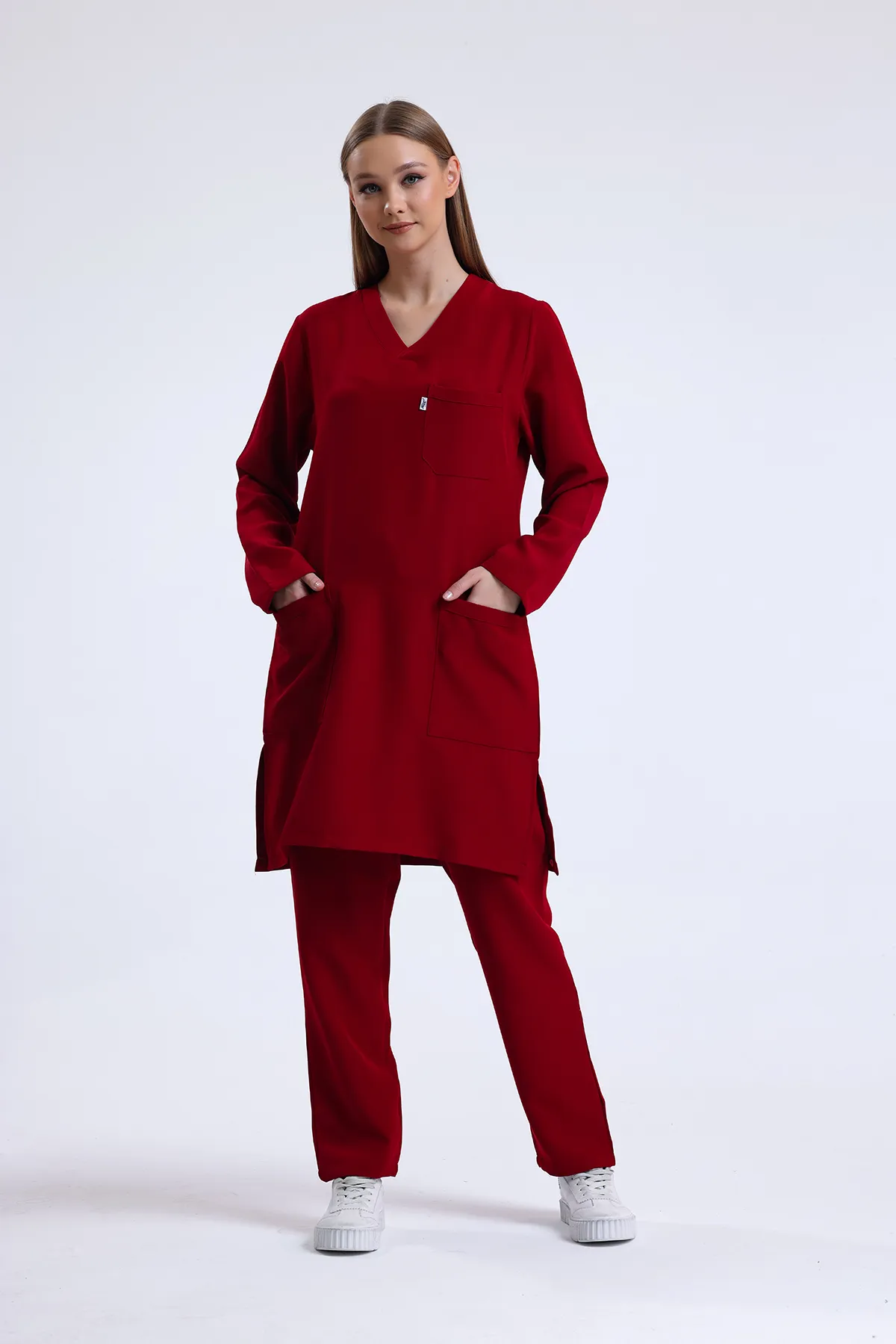
Physicians, nurses, technicians, front-desk staff, and cleaning personnel don't do the same physical work. A single corporate color can apply across every role, but pocket placement, sleeve style, and pattern won't necessarily suit each function equally. The front-desk uniform and the exam-room garment don't have to solve the same problem.
Each top, pant, coat, and jacket should be defined as its own model, since TB Uniform's 100-piece minimum applies per color and per model, not to the order as a whole. How sizes get distributed within that quantity should be confirmed in writing at the quoting stage, not assumed. For larger facility structures, the department-level planning approach in the hospital staff uniform supplier guide applies just as well.
What fabric criteria matter for a clinic uniform?
Clinic uniform fabric should be compared on at least 4 criteria: weight, fiber ratio, dimensional stability, and colorfastness.
A standard scrub worn in a private practice or outpatient clinic is not the same product as protective apparel for operating-room staff or roles with fluid exposure. Fabric selection should state shift length, range-of-motion needs, laundering method, and seasonal conditions. "Quality fabric" on its own is not a workable spec.
Spandex-blend fabrics can improve range of motion, but finished measurements and post-wash dimensional change still need to be verified on the actual sample. If an antimicrobial finish is requested, the active substance, test method, wash durability, and the specific performance claim all need separate documentation. The antibacterial scrub fabric properties guide covers what that documentation should look like.
Where does a uniform stop and PPE start?
A standard clinic uniform and personal protective equipment can look identical and still require different risk assessments and different compliance documentation.
A standard uniform carries staff identity and corporate appearance. Personal protective equipment exists to protect against a defined workplace hazard, and the two shouldn't be evaluated on the same checklist. Any product claiming surgical-gown status, chemical protection, or another PPE function needs its own regulatory review against the applicable standard.
TB Uniform's production is based in Turkey. Turkish workplace-safety regulation, specifically the Regulation on the Use of Personal Protective Equipment in the Workplace, governs how a Turkish employer runs its own risk assessment and equipment selection. That framework applies to operations inside Turkey; it is not the standard a US clinic uses for its own PPE program, which typically sits under OSHA. A US buyer sourcing private-label clinic apparel from a Turkish manufacturer should keep the two separate: the manufacturer's compliance context in Turkey does not substitute for the buyer's own domestic PPE determination, which should go through the clinic's own safety and compliance staff.
How should corporate color and logo work be approved?
Logo approval should rest on at least 4 data points: size in centimeters, placement, color reference, and the embroidery or print technique to be used.
A logo file on screen doesn't show what happens on fabric. Dense embroidery can pucker lightweight material, and print technique should be chosen based on the garment's laundering conditions. Logo, text, and department name should all be checked on a sample made from the actual production fabric. A digital mockup approval isn't a substitute for that step.
TB Uniform runs printing and embroidery in-house and supports custom patterns, colors, models, and private-label production. Organizations extending one clinic identity across multiple job functions can use the color-and-model matrix approach in the corporate identity uniform design guide.
How should size distribution be verified?
A sizing plan should reconcile at least 2 sources: actual staff measurements and the manufacturer's finished-garment measurement chart.
An S, M, or L label is not, by itself, a technical measurement. Chest, waist, hip, garment length, and sleeve length should be defined per model, and staff should test reaching, sitting, and bending movements during a fit trial.
How different sizes get distributed within the 100-piece minimum for a given color and model isn't specified on a standard price sheet, and that detail needs to be confirmed before the order is placed. Reserve stock for new hires and size changes should be part of the facility's own inventory policy, not something assumed into the base order.
What should sample approval cover?
A clinic uniform sample should be reviewed against 7 items: fit, fabric, color, stitching, pockets, logo, and care outcome.
TB Uniform's standard sample lead time is 5 to 7 business days once the required technical details are finalized. The sample should document finished measurements, range of motion, pocket function, neckline, seam appearance, and logo placement, not just a visual check.
If a wash trial is required, the process conditions and measurement method should be agreed in advance, and every revision needs a date and version number. A sample checklist template is available on the wholesale uniform sample request page.
How should certificate scope be checked?
Certificate review should cover at least 4 fields: the certificate holder, product scope, validity date, and how the certified material relates to what's actually being ordered.
OEKO-TEX STANDARD 100 tests textile products and components for a defined list of harmful substances. It does not indicate that a product qualifies as protective apparel, that it delivers antimicrobial performance, or that it will hold up to a specific number of wash cycles. Each of those is a separate claim, and each needs its own evidence.
ISO 9001 is a quality management system standard. A certificate shouldn't be treated as covering every product line without checking which manufacturer, activity, and facility it actually scopes. GOTS and REACH claims, where relevant, also need to be verified separately against the specific fabric and supply chain in use.
How should the delivery and acceptance process be set up?
At TB Uniform, production and delivery after sample approval generally take 4 to 6 weeks; sample revisions need to be finished before that window starts.
The order calendar should have separate dates for fabric sourcing, production, quality control, and shipping. TB Uniform's production capacity can reach up to 50,000 pieces per month depending on the product group, with the exact allocation set by order structure.
Acceptance checks should log carton count, product code, color, size, logo, and measurement tolerance. For a decision tied to Turkey's private-hospital regulatory framework, the current Private Hospitals Regulation and the clinic's own compliance staff should be the reference. A US or other foreign clinic's own regulatory obligations sit under its home jurisdiction and run independently of that Turkish framework.
Frequently asked questions
What is the minimum order quantity?
TB Uniform's minimum order is 100 pieces per color and model. Scrub tops and pants may need to be treated as separate models. How different sizes get distributed within that quantity, whether one color code counts as shared across different models, and how reserve stock fits into the order structure should all be confirmed before quoting.
How many days does a clinic uniform sample take?
Once the technical drawing, measurement chart, fabric expectation, color, and logo file are finalized, standard sample lead time is 5 to 7 business days. Shipping time and any buyer-requested revisions add to that schedule separately. The sample version used for sign-off should be stated explicitly on the approval form.
How long does delivery take after ordering?
Production and delivery generally take 4 to 6 weeks after order approval. The final schedule depends on fabric availability, model count, order quantity, and shipping conditions. A date given before sample approval is complete shouldn't be treated as a confirmed production start.
Can different sizes go into the same order?
A quantity plan for different sizes can be built, but how that size distribution applies against the 100-piece minimum per color and model needs to be confirmed by TB Uniform on a project basis. The buying team should list staff count, finished-garment measurement, and required reserve quantity separately for each size.
Is an OEKO-TEX certificate sufficient for a clinic uniform?
No. OEKO-TEX STANDARD 100 shows the scope of testing for specific harmful substances. On its own, it is not proof of PPE suitability, antimicrobial effectiveness, or wash-life performance. The certificate number, its scope, its validity, and its relationship to the fabric being selected should all be checked before ordering.
How do you get a quote for clinic uniforms?
Model drawings, color and size quantities, fabric expectations, the logo file, packing format, delivery point, and target date should all go into a single file. You can request a sample and quote from TB Uniform using that technical file. Unit price, payment, and shipping terms should be compared in the written proposal.